
With the June primary largely settled and two major local announcements arriving on the same day, the contours of Santa Monica’s November election are finally coming into focus.
While some uncertainty remains around who else may enter local races, voters now have a much clearer sense of both the candidates and issues likely to dominate the fall campaign.
Ben Allen Advances, Other Local Candidates Fall Short
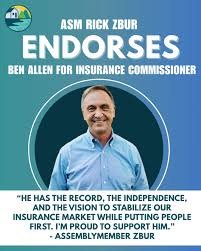
The biggest winner with Santa Monica ties was State Senator Ben Allen, who advanced to November in the race for California Insurance Commissioner. Allen was the only Santa Monica-based candidate to emerge from Tuesday’s primary with a path to higher office after several other local hopefuls came up short.
For Santa Monica voters, Allen’s success means the city will continue to have one hometown candidate on the statewide ballot this fall.
In the race to replace Allen, Republican G. Rick Marshall and Democrat Brian Goldsmith were leading in early returns, each with nearly 20% of the vote. Democrat and West Hollywood City Councilmember John Erickson had over 16% of the vote, and could find himself in the runoff if write-in ballots break towards the Democrats.
Assemblymember Rick Chavez-Zbur cruised to re-election facing no serious opposition.
A Bad Night for Santa Monica Natives
Election night proved to be a bad night for Santa Monicans seeking higher office.
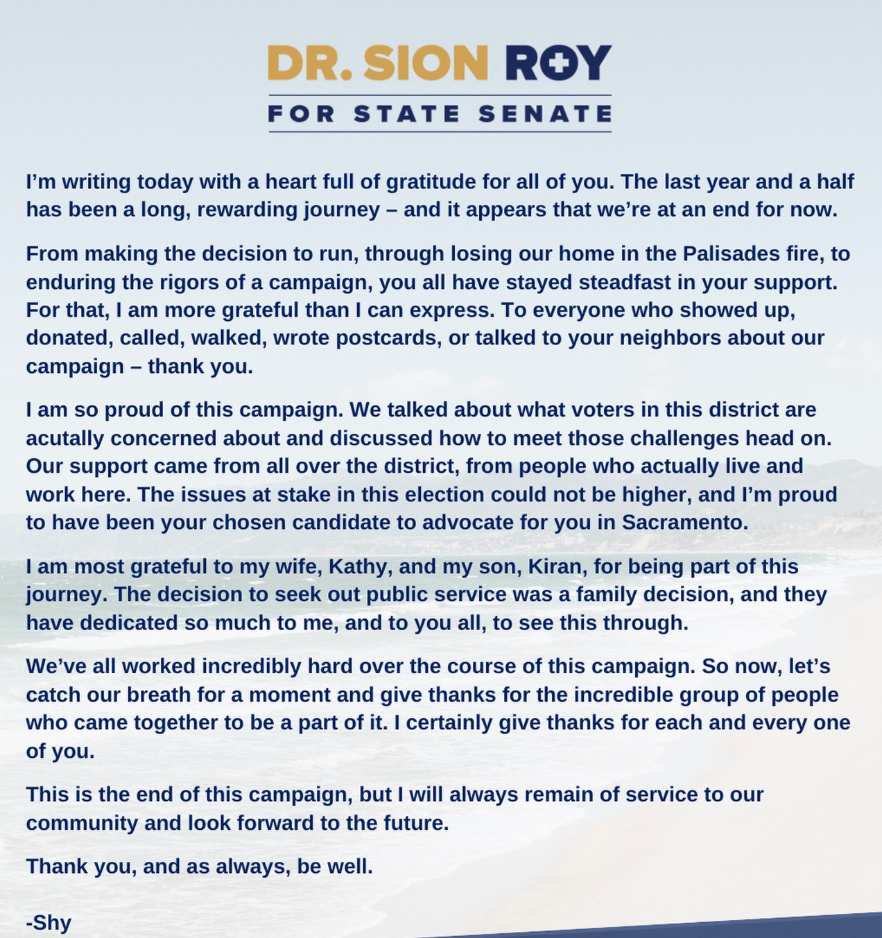
Dr. Sion Roy, who has twice been elected to the Santa Monica College Board of Trustees appears to be out of the race for State Senate. Roy was fifth as the counting stopped on Tuesday night, but was third among Democrats behind Goldsmith and Erickson. So even if there is a blue wave, it would likely sweep Erickson into the general election, not Roy.
Former Santa Monica Mayor Tony Vazquez failed to advance in the race for State Treasurer, finishing a distant 5th.
Another former Santa Monica Mayor, Mike Feinstein, brought in just under 3% of the vote in the race for Secretary of State. Feinstein, running under the Green Party banner, was an extreme long shot and was running more to advance causes in which he believes such as changing the current electoral system with “ranked choice voting.”
Airport Housing Measure Withdrawn, Brock Returns to the Ballot
But not all of the election news was made at the ballot box yesterday.
(Update: Cloverfield Commons has released a letter stating that the measure is still on. Read all about it. Original reporting below)
The biggest surprise came when supporters of the proposed “Cloverfield Commons initiative” ended their effort to qualify the measure for the November ballot. The proposal would have allowed up to 3,000 affordable housing units on a portion of the future Santa Monica Airport site while reserving most of the land for parks and open space. Supporters concluded they would not gather enough signatures to qualify the measure in time for the election.
The withdrawal removes what would likely have been the most contentious ballot measure of 2026. Supporters viewed the airport as a once-in-a-generation opportunity to address Santa Monica’s affordability crisis, while opponents argued the land should remain overwhelmingly dedicated to park space. The proposal had already exposed divisions within Santa Monica’s progressive community and within Santa Monicans for Renters’ Rights.
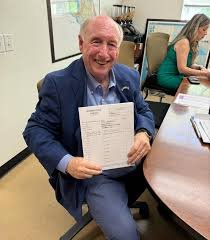
Just hours earlier, former Santa Monica Mayor Phil Brock announced in the Santa Monica Lookout that he will seek to return to the City Council after finishing fifth in a race where the top four are “winners” just two years ago. Brock, who also served the city on a bevy of committees and commissions over the years, told the Lookout he will seek office as an independent, and is not planning to run as part of a slate.
Brock was elected to office in 2020, when he led a slate that won three of the four seats on the Council, unseating a trio of incumbents. Brock was appointed Mayor in 2024, and while he had his critics, he clearly relished being the city’s mayor and serving on the Council.
