

If you drive, walk, or bike around Santa Monica, you’ve seen them: white and yellow plastic bollards—those flexible posts meant to protect bike lanes or tighten corners—lying flat on the ground, mangled by the tires of a passing SUV or a delivery truck. To a frustrated resident, a mangled plastic post looks like a failure of city maintenance. To a city staffer, it can look like a never-ending work order.
I’ve come to see those broken pieces of plastic differently. They are actually some of the most honest data we have about how our streets are really functioning—where design intentions and driver behavior diverge. If we learn to read them properly, they have something important to teach us about investing our limited street-safety budget more wisely.
The “Sneckdown” Logic
Planners in colder climates have a useful concept called the “sneckdown”—a portmanteau of “snow” and “neckdown.” When it snows, car tires carve out only the paths they actually need, leaving untouched snow in the margins where the road is wider than necessary. Planners can use those snowy outlines to identify exactly where a curb could be extended to calm traffic or reclaim space for pedestrians—without committing to any permanent construction first.
The insight is powerful precisely because it comes from observed behavior rather than modeled assumptions. Traffic models predict how people should move through an intersection. Snow reveals how they actually do. There’s no argument to be had with snow.
This week’s high temperatures serve as a reminder that Santa Monica doesn’t get snow. But we do have an equivalent: our quick-build infrastructure. The plastic posts and rubber bumps deployed as part of our Vision Zero and Measure K-funded safe streets work are, in a real sense, our version of snow. When a bollard is repeatedly hit—flattened again and again at the same location—it’s not just a maintenance headache. It’s a revealed truth. It tells us that a turn radius is still too wide, that a lane configuration is confusing drivers, or that someone is habitually cutting a corner at dangerous speed. The bollard isn’t failing. It’s gathering data.
Cities that have embraced quick-build approaches have learned that this kind of feedback is genuinely hard to get any other way. You can model intersection geometry. You can survey residents. You can review crash data. But the pattern of destroyed bollards gives you something different: a continuous, unsolicited record of where human behavior and street design are in conflict, updated with every delivery truck that clips a corner.
From Oops to Evidence
This is the shift from “Oops” to “Evidence.” Instead of just replacing the post and waiting for the next hit, we should be using that destruction as a survey. It tells us exactly where we need to “harden” the street with permanent concrete curbs or planters.
According to the NACTO Quick Builds for Better Streets guide, an “Agile Design” approach allows the City’s traffic painters and engineers to “test” a design in real-time. If the plastic stays upright for a year, the design is a success. If it gets destroyed in a week, we’ve learned a vital lesson before we ever pour a drop of expensive, permanent concrete.
A Case Study in Costs: 26th and Santa Monica Blvd
Infrastructure is expensive, especially when it requires heavy engineering. We are currently witnessing a slippery slope towards heavy engineering with Council direction regarding the Santa Monica Boulevard Safety Study. At that meeting, the city council gave direction to move the eastbound bus stop at 26th Street from the near side to the far side of the intersection.
The case for far-side stops is genuine and well-established. Transit planners have long understood that placing a stop after an intersection reduces delays caused by buses blocking signal phases, limits conflicts with right-turning vehicles, and can meaningfully improve schedule reliability on congested corridors. And with a dozen or so buses per hour on Santa Monica Boulevard, those seconds add up.
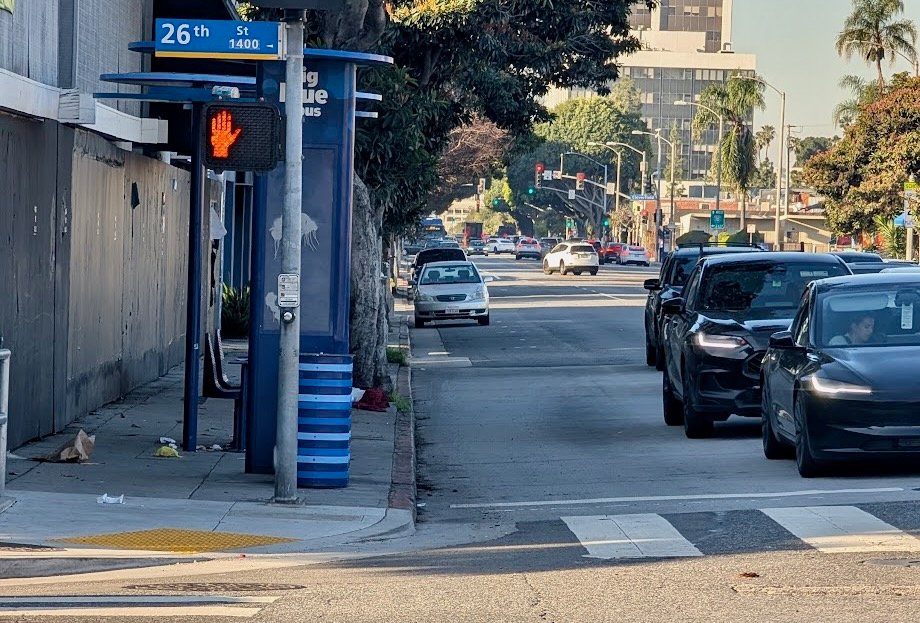
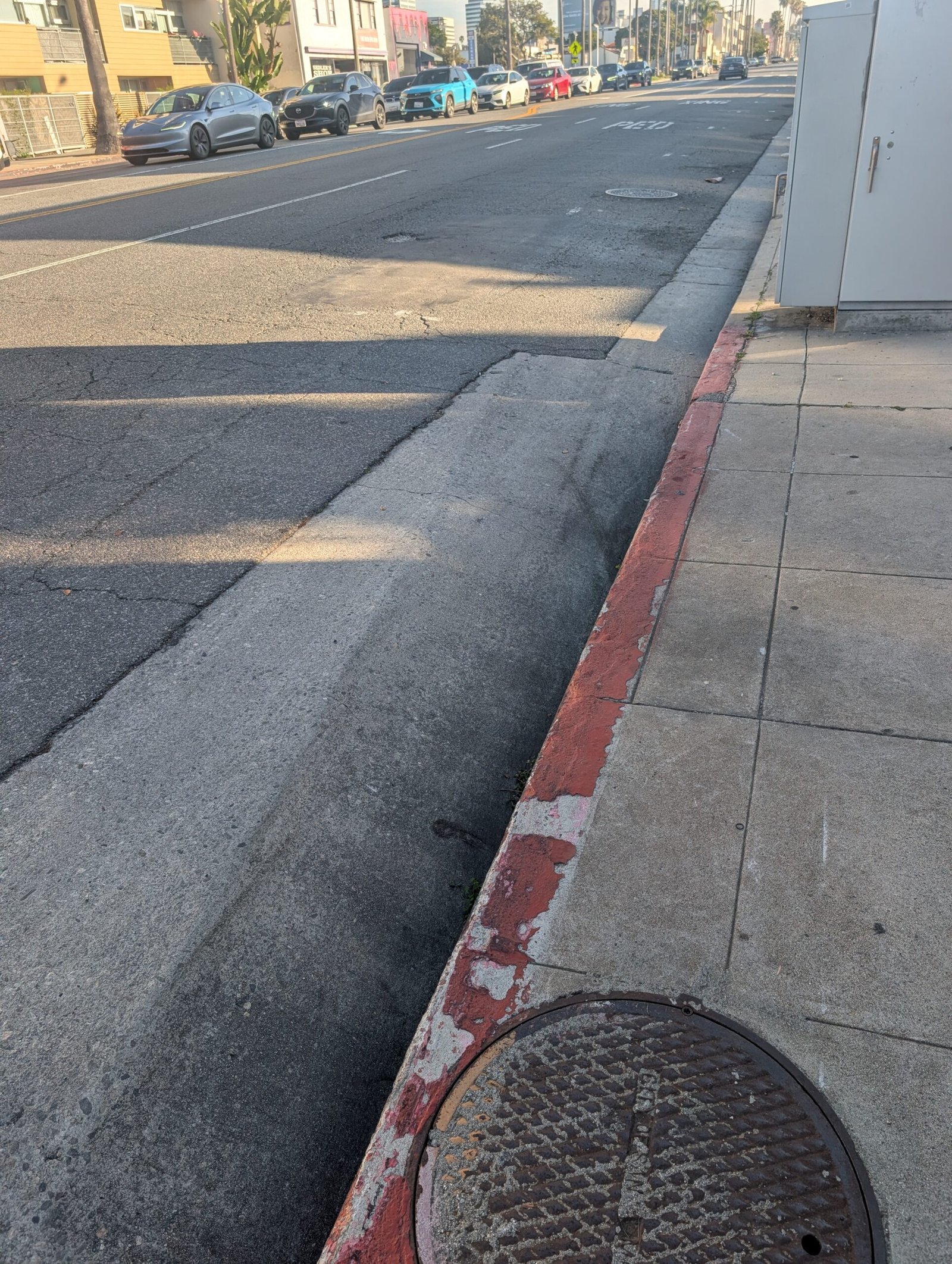
In practice, though, this particular relocation runs into a significant obstacle: cost. The near-side stop at 26th Street is not just a sign and a bench. It is a substantial piece of transit infrastructure: a city shelter with a real-time information display and a roughly 120-foot reinforced-concrete bus pad. That concrete is there for an important reason. Standard buses weigh up to 40,000 pounds, and repeated braking and acceleration cycles exert significant downward and horizontal shear forces on the roadway surface. On standard asphalt, that stress causes pavement to “shove” and ripple over time, requiring frequent and expensive repairs. Because this stop serves three major routes—Metro 4 and Big Blue Bus lines 1 and 10—the reinforced pad is essential to the road’s long-term durability.
To move the stop to the far side, the City would need to construct a new reinforced concrete pad at the far-side location and reconstruct a flood control drain that sits directly in the path of the proposed bus pad relocation. My back-of-envelope cost estimate for that work is at least $250,000—just to move a bus stop that is already functioning.
Opportunity Costs and the Political Gap
A quarter of a million dollars is a significant sum in the context of Santa Monica’s street safety budget. As I noted in an earlier column on what it will take to reduce traffic fatalities, Measure K raises approximately $6.7 million annually, with half given to safe streets projects per the ballot language and this council’s direction. That sounds substantial until you price out what street safety infrastructure actually costs: a fully signalized intersection runs roughly $1 million, and—as that piece detailed—the long-delayed signal at Wilshire and Chelsea remained in a funding queue even after a fatal crash at that location in late 2024. Spending half of one year’s Measure K allocation to relocate a functioning bus stop raises a genuine question about priorities.
Perhaps the city could pursue external transit-specific funds could relocate the stop. However, many of the city’s transit stops have inadequate or non-functioning lighting and there are other stops with crumbling infrastructure, all of which merit repair over this stop’s relocation.
This is not a criticism of the far-side stop rationale, which is sound. The issue is structural. When every project is routed through a full capital-improvement workflow, the resulting menu of options tends toward expensive, permanent interventions. Faster and cheaper alternatives that might achieve 80 percent of the benefit at 10 percent of the cost don’t receive the same level of planning and engineering analysis.
An agile alternative is available here. Rather than relocating the stop, the City could achieve much of the same transit-priority benefit through a combination of a transit queue jump (a signal phase that gives the bus a head start before general traffic) and a short, dedicated transit lane on the approach to the intersection. Neither requires relocating any infrastructure. Both can be implemented with paint, signal timing changes, and modest hardware. Both can be monitored and adjusted. And both would leave the remaining budget available for other safety priorities awaiting funding.
The Santa Monica City Council’s unanimous February 2026 vote to return the Santa Monica Boulevard Safety Study recommendations to staff—asking for alternatives that more directly prioritize safety outcomes—reflects a broader tension that has been building. The challenge isn’t that City staff are indifferent to that direction. It’s that the standard project development process wasn’t designed to produce fast, low-cost interventions. It was designed to produce durable, well-engineered ones. Bridging that gap requires not just a policy directive, but new workflows and new ways of evaluating options. Elsewhere in the safe streets toolkit, Santa Monica has been making progress: my December column on new state laws that expand automated enforcement options outlines some of what is now available. The question is how to integrate those options into a coherent, prioritized program.
A New Workflow for Safe Streets
Treating broken bollards as data rather than failures is the foundation of a different kind of street safety practice—one that moves at something closer to the speed of the problem.
The approach starts with rapid deployment. Paint and plastic first, to address documented safety problems as they are identified, rather than five years from now when a capital project is fully funded and designed. This is not a consolation prize for lacking resources for “real” infrastructure. It is an intentional first phase. Quick-build installations create immediate safety benefits while simultaneously generating the real-world evidence needed to make smarter permanent investments.
The second step is systematic observation. This means tracking where bollards are being hit, how frequently, and under what conditions—and deliberately routing that maintenance data back to the engineers and planners who can act on it. Santa Monica’s maintenance crews already have this information. The question is whether it is being used as a planning input or just a work order trigger.
From that evidence base, the third step is analysis: understanding why the bollard is getting hit. Is the turn radius still too wide? Is the lane striping ambiguous? Is one category of vehicle—delivery trucks, transit buses, rideshare vehicles queuing at the curb—responsible for most of the conflicts? The answer shapes what the permanent solution should be, and how urgently it is needed.
Finally, targeted hardening: spending the substantial money on concrete curbs, curb extensions, planters, and signal infrastructure only where the quick-build data has confirmed both the safety need and the design solution. Not as a substitute for investing in permanent safety infrastructure, but as a way to ensure that every dollar of that investment goes where it will do the most good.
Santa Monica’s Local Roadway Safety Plan has already identified where our streets are most dangerous. We do not need another study to tell us that. What we need is a practice that turns the evidence our streets are already generating into faster, smarter interventions.
