

Assemblymember Rick Zbur (D-Santa Monica)’s legislation to reduce the power and influence of the coastal commission has already gone through a lot of changes as it has sailed through committee votes and is now on its way to the Assembly floor before heading to the Senate and the Governor’s Desk.
While the scaled-back legislation hasn’t faced much criticism in Sacramento, community groups in Santa Monica are rallying to try and stop, or change, the legislation.
Assembly Bill 1740, would reduce the number of projects in Santa Monica that require approval from the California Coastal Commission. The bill creates exemptions from Coastal Development Permit requirements for certain housing projects, bike and transit improvements, accessibility upgrades, parking changes, and temporary events in already-developed areas.
Supporters say the measure would speed up housing and transportation projects that are currently delayed by lengthy permit reviews, while critics argue it weakens environmental oversight in the coastal zone. The bill was amended to apply specifically to Santa Monica and would sunset in 2037. The bill is sponsored by Zbur, Assemblymember Buffy Wicks (D-Oakland), the City of Santa Monica, and Abundant Housing.
Opposition and Debate
Shortly after AB 1740 passed the Senate Housing Committee last month, debate over the measure heated up in Santa Monica. A local environmentalist authored two pieces attacking the legislation, the city’s co-sponsorship of the legislation without a City Council vote, and the testimony of Councilmember Dan Hall who supported the measure. Hall responded in his own op/ed and then the original author responded again.
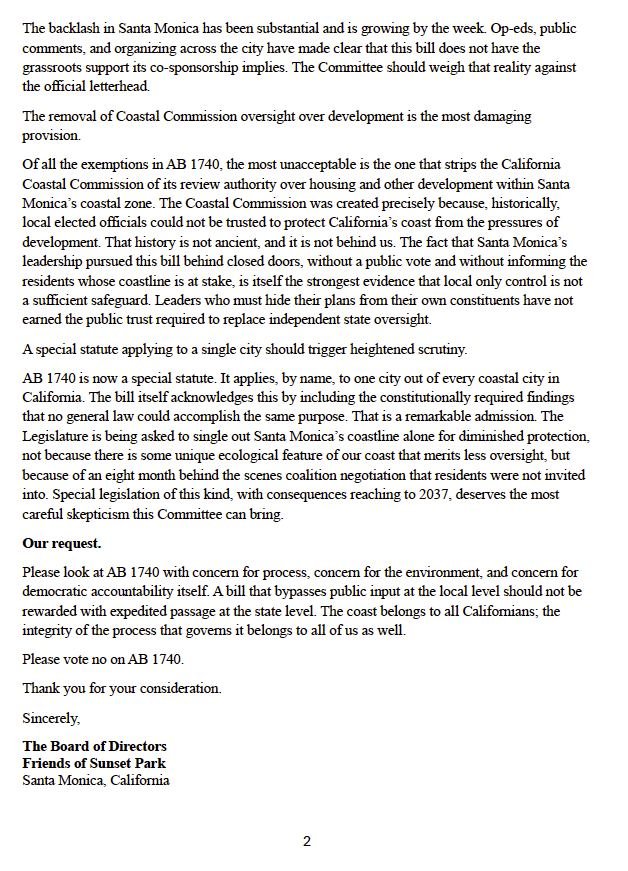
Following the war of words in the Daily Press, several of the city’s community groups sent letters to Assemblymembers and the local press announcing their opposition. In addition to objections over the loosening of restrictions, they also objected to the city’s support for the measure without a vote of the City Council.
While they may be attacking the legislation from a couple of angles, for local housing advocates the issue goes back to familiar grounds: how the city grows as it tries to meet state housing requirements.
“Beach parking lots, sensitive habitat, and sea level rise planning are all explicitly untouched,” explains Bradley Ewing, the co-chair of Santa Monica Forward.
“The environmental case is affirmative: every home refused near transit is one built on a wildfire-prone hillside or a commute pushed deeper into inland sprawl. Strip away the process arguments and what’s left is the real objection for much of the opposition: building more housing in Santa Monica.”
Is Santa Monica Moving on an LCP?
Another criticism of the legislation, pushed by Coastal Commission staff at the legislative hearings AB 1740, is that Santa Monica is looking for special treatment when it could pass a Local Coastal Program (LCP) and be exempted from many of the Coastal Commission rules AB 1740 addresses. The city council announced an emergency meeting tonight to discuss finally passing an LCP.
The 1976 California Coastal Act requires coastal cities and counties to create LCPs, which guide development and conservation in the coastal zone. Each LCP includes land use policies and implementation rules that shape how coastal resources are managed over time. While tailored to local communities, LCPs must also meet statewide Coastal Act goals and are reviewed by the Coastal Commission for consistency with state standards.
Santa Monica is one of the few coastal cities that don’t have an LCP, and regardless of where one stands on AB 1740, both sides of the aisle agree that passing an LCP is a better idea than a legislative remedy.
“What has become clear through this process is that the legislative conversation in Sacramento has created a unique window to resolve the LCP issue in a way that serves Santa Monica’s long-term interests. That is the outcome we are focused on,” writes Santa Monica Mayor Caroline Torosis, who has supported AB 1740 (full statement below.)
Santa Monica Councilmember Lana Negrete, who opposes AB 1740 in large part because of the housing portions of the legislation, agrees that Santa Monica pursuing an LCP is the way forward.
“If there is one positive outcome from the significant public concern and backlash surrounding AB 1740, it is that it has accelerated the urgency around finally pursuing a Local Coastal Plan in a serious and transparent way,” writes Negrete. “That is the direction I believe we should be focused on moving forward.”
Negrete’s full responses to Streetsblog/Next’s questions can also be found at the end of the article.
Full Statement from Mayor Torosis:
My commitment to the goals behind AB 1740 has not changed. Santa Monica has spent nearly a decade trying to obtain a certified Local Coastal Program, and the core problem this legislation addresses is real: cities that have demonstrated responsible stewardship of their coasts should have a more predictable path to managing routine, low-impact projects locally. What has become clear through this process is that the legislative conversation in Sacramento has created a unique window to resolve the LCP issue in a way that serves Santa Monica’s long-term interests. That is the outcome we are focused on.
Assemblymember Zbur has been responsive to the concerns raised, and conversations about amendments are actively underway. The housing provisions in particular are being revisited, and I think that is the right direction. The strongest case for this legislation has always been about coastal access, transportation, and streamlining routine improvements. All parties now have a shared interest in resolving Santa Monica’s Local Coastal Program, and we have a unique window to make progress on an issue that has been stalled for over ten years. A certified LCP is fundamentally in Santa Monica’s best interest, and this Council is committed to getting it done.
Full Question and Answer from Councilmember Negrete
- Did you attend the hearing in support of AB 1740 or in support of Councilmember Hall’s testimony?
No. I did not attend the hearing to support the bill or to support Councilmember Hall’s testimony. I was already attending the League of California Cities conference and chose to sit in on the committee hearing so I could listen directly to the discussion taking place around the bill.
Being present in the hearing room should not be misconstrued as endorsing testimony or supporting the bill in its entirety.
- What is your position on the bill itself?
I have consistently stated publicly that there were portions of the bill I understood and appreciated, particularly the effort to help coastal cities move more efficiently on economic activity, outdoor dining, events, restaurant activation, and business opportunities that are often slowed by Coastal Commission processes.
I appreciate the Assemblymember trying to find solutions that would help cities like Santa Monica avoid unnecessary delays that impact local businesses and community events.
However, I was also very clear, both publicly and privately, that I could not support the housing components of the bill or the narrow focus on Santa Monica in its original form. I expressed those concerns directly to legislative leaders, Coastal Commission representatives, and members of the community throughout this process.
- What do you believe is the best path forward?
I continue to believe the better long-term solution is pursuing a transparent and community-driven Local Coastal Plan process.
That is the real work. It takes time, collaboration, public engagement, and thoughtful planning, but it ultimately gives cities more local clarity and accountability rather than relying on piecemeal legislative fixes or last-minute negotiations.
If there is one positive outcome from the significant public concern and backlash surrounding AB 1740, it is that it has accelerated the urgency around finally pursuing a Local Coastal Plan in a serious and transparent way. That is the direction I believe we should be focused on moving forward.
