
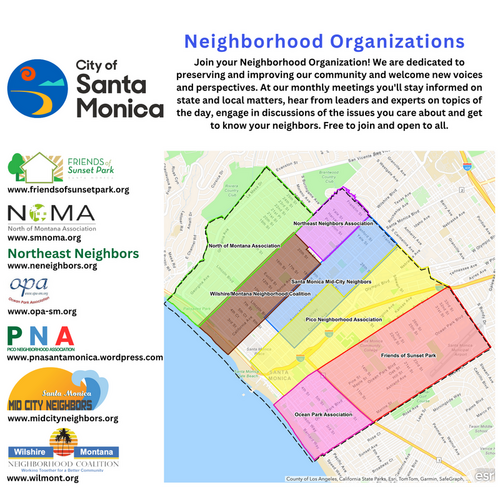
Image: The “new map” on the city’s website showing the four neighborhood organizations taking part in the city’s grant program.
Last month, the City of Santa Monica changed its website for community involvement by reducing the number of recognized neighborhood associations from seven groups to four groups. The change was made after the city implemented a new program for distributing funds to neighborhood groups, a grant system that three groups that had been receiving funds refused to take part in.
The groups still formally recognized by the city include the Ocean Park Association, the Santa Monica Mid-City Neighbors, the Pico Neighborhood Association, and the Wilshire/Montana Neighborhood Coalition.
The groups that chose not to take part in the new program include Northeast Neighbors, North of Montana, and Friends of Sunset Park. All three groups that decided not to take part in the program are 501c(4) organizations, a tax-exempt social welfare organization defined under the U.S. Internal Revenue Code. These organizations are allowed to make endorsements in political elections under federal law. However, organizations that make political endorsements are not allowed to participate in the city’s new grant program.
“The City tried to silence us by holding back money,” opined Northeast Neighbors Boardmember Tricia Crane on a Facebook page that discusses local politics. “We are not for sale.”
But Santa Monica was an outlier in allowing neighborhood organizations that received city funds to make political endorsements before this change. Staying out of local politics is a common requirement to access public funds in cities throughout Los Angeles County and the state, including in the City of Los Angeles.
Brief History of Changes
Following the 2024 election, the City of Santa Monica proposed changes to how it distributes funds to neighborhood groups. Rather than having seven “officially recognized” groups that receive a grant allocated for communications as part of the city’s annual budget, it would accept grant applications for communications and other public events provided the organizations meet certain requirements. Some of these requirements proved controversial, including the organization itself not being involved in political endorsements regardless of their federal status, not using communications funds to reach out beyond their membership list, and providing the city with demographic information of their membership.
The latter requirement, while well intentioned, created an unintended controversy for the city. The demographic requirement was intended to insure that groups were in-line with the demographics of the areas they represented. However, that requirement raised privacy concerns and proved burdensome for some groups that weren’t collecting that information on membership forms. The city eventually amended this requirement to make it less intrusive and easier for groups to comply.
The current requirements to submit a grant to the city for a neighborhood group are now:
- Represent a commonly recognized neighborhood within Santa Monica.
- Submit a complete Neighborhood Organization Grant Program Application, including a Proposed Use of Funds Plan approved by the City Manager’s Office prior to expenditure of funds.
- Possess tax-exempt status as a nonprofit organization under Section 501(c)(3) or Section 501(c)(4) of the Internal Revenue Service Code, or Section 23701(d) or 23701(f) of the California State Franchise Tax Code.
- Have an active board of directors or officers elected in accordance with organizational bylaws. All board meetings shall be open to the public in compliance with applicable laws. If meetings are held virtually, access information shall be publicly posted and made readily available as required by applicable law.
- Publicly post its current organizational bylaws on its website and maintain such posting throughout the term of this Agreement.
- Hold at least one general membership meeting annually.
- Maintain a membership list of at least 50 active members (residing at separate addresses) or 10 percent eligible households within the neighborhood boundaries as defined in the bylaws, whichever is less.
- Submit demographic data (age, income, housing tenure (renter or homeowner).
But How Controversial Are These Changes?
The Santa Monica Lookout and Santa Monica Daily Press have covered the changes to the grant program and recognition of neighborhood groups as a major controversy, treating the three groups that have refused to take part in the new program as a near majority. While it is certainly true that the numbers three and four are close numerically, it’s also true that the three formerly officially recognized neighborhood groups that are not taking part in the program represent the 4th, 6th, and 7th largest groups in the city.
According to the most recent census, there are 88,730 people represented by the seven neighborhood groups. The three groups that are not taking part in the program represent 29,041, 32.41% of people. The other four groups represent 59,689 people, the remaining 67,59% of people.
(A list of the city’s seven neighborhood associations, with the number of people living within their boundaries, listed from largest to smallest. Groups in bold are the ones not taking part in the city’s new grant program for neighborhood associations.)
Wilshire/Montana Neighborhood Coalition: 18,847 residents
Pico Neighborhood Association: 15,738 residents
Santa Monica Mid-City Neighbors: 15,005 residents
Friends of Sunset Park: 14,967 residents
Ocean Park Association: 10,099 residents
North of Montana Association: 9,996 residents
Northeast Neighbors Association: 4,078 residents
What if I Live in an Area Where Represented by a Group That Opts-Out of the Grant Program?
The new grant program allows for new organizations to spring up and collect these city funds, as long as they meet the requirements listed above, but for new organizations it can take up to six months to earn the needed IRS designation. At the moment, there is no new neighborhood organization that has sprung up to try and “replace” any of the groups that have not participated in the program, despite jokes one may have heard online about potential names for new neighborhood groups such as “Friends of Friends of Sunset Park” or “South of Entrada Association.”
