

(Sean Noonan is an environmental planner. He also teaches urban planning at CSU, Fullerton. This is the second time he’s written on Vehicle Miles Traveled analysis in California with Streetsblog. Want to share your own thoughts and research on VMT? Email damien@streetsblog.org)
Under Senate Bill (SB) 743, vehicle miles traveled (VMT) replaced Level of Service (LOS) as the primary transportation impact metric that is used for the purposes of the California Environmental Quality Act (CEQA), shifting analysis from congestion to how many miles are traveled per person over a given period of time. While VMT was intended to more directly address climate impacts, the way it is implemented today often leads to outcomes detached from actual travel behavior or greenhouse gas performance. Also, the current way practitioners implement VMT produces inconsistent, inequitable, and sometimes illogical outcomes. These inconsistencies raise an important question: is the VMT framework achieving its climate and land-use goals?
In this article, I explore the winners and losers of the VMT system here in California. Examining how SB 743 is playing out for real projects reveals sharp differences in who benefits and who faces new burdens from SB 743. First, we start with the “winner” project types that are not adversely affected by the new VMT system.
WINNER: Heavy-Duty Trucks
There was a huge carve-out in the SB 743 legislation for heavy-duty trucks, and the land uses that depend upon heavy-duty trucks. Section 15064.3, subdivision (a), states, “For the purposes of this section, ‘vehicle miles traveled’ refers to the amount and distance of automobile travel attributable to a project.” Here, the term “automobile” refers to on-road passenger vehicles, specifically cars and light trucks.” These rules do not require that heavy-duty trucks be evaluated in VMT analyses. Does it make sense that we are exempting heavy duty trucks from VMT evaluation if the goal is combating climate change?
WINNER: Projects Near High Quality Transit
As outlined in CEQA Guidelines Section 15064.3, projects within one-half mile of either an existing major transit stop or a stop along an existing high quality transit corridor should be presumed to cause a less than significant impact related to VMT. This approach to evaluating a project presumes that people will actually use transit if it is available. However, we do not know if this will actually be the case because it is uncertain what the future users’ behaviors will actually be once any given project is actually built.
WINNER: Projects that are Locally-Serving Retail, Public Facilities, and Essential Services
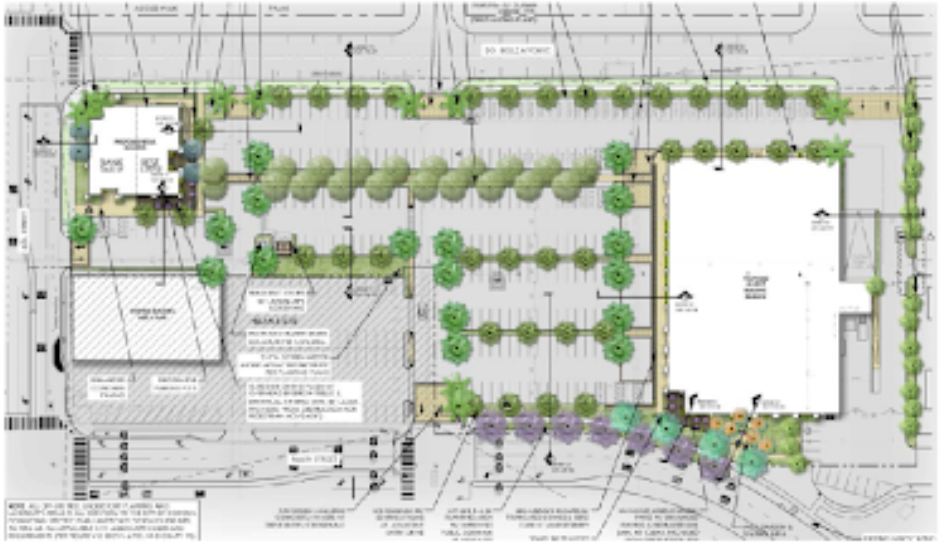
Many cities and counties automatically exempt local-serving retail, public facilities, and essential services from VMT analyses without any well-documented rationale for doing so. One example is the Northgate Gonzalez Market & Commercial Project, which proposes to construct a 40,000 square foot market, and to remodel an existing bank on the site and develop a new restaurant pad on a site in Corona (Corona 2025a). Even though the EIR disclosed that this project would generate 3,377 daily vehicle trips, this project was not required to evaluate or mitigate for any VMT impacts since the project is locally-serving. A site plan for this project is provided as Figure 1, which shows the multitude of parking that would be provided for this project, VMT be damned!
WINNER: Categorically Exempt Projects
We have whole categories of projects in CEQA that are categorically exempt from CEQA that do not need to prepare an Initial Study (IS) or an Environmental Impact Report (EIR). By being able to avoid the CEQA process, these projects also avoid having to prepare VMT studies. Examples of categorically exempt projects that typically do not need to evaluate or mitigate for VMT include Class 3 (New Construction or Conversion of Small Structures), Class 4 (Minor Alterations to Land), and Class 14 (Minor Additional to Schools) categorical exemptions, which can be used to exempt from CEQA many projects that would generate VMT.
WINNER: Statutorily Exempt Projects
In addition to categorical exemptions, we also have statutory exemptions that allow for certain developments to avoid studying and mitigating VMT. For example, as recently authorized by AB 130 in 2025, housing development projects that are under 20 acres may qualify as statutorily exempt from CEQA when the project also meets zoning, density, and environmental criteria. There will be many fortunate project types that are located on suburban sites far from transit-rich areas that will not be required to analyze or mitigate VMT by using this new exemption. We also have a statutory exemption on the books that exempts all new and modified railroad grade separation projects per Section 15282(g) of the State CEQA Guidelines, regardless of their VMT or other environmental impacts.
WINNER: Projects in Low-VMT-Generating Areas
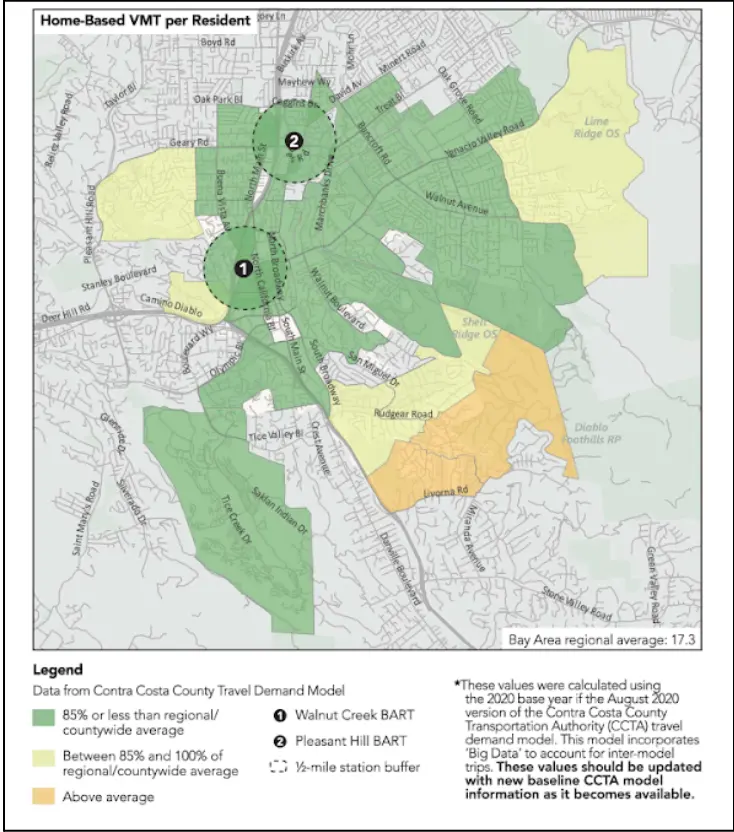
The VMT process presumes that projects built in low-VMT-generating areas will automatically have less than significant impacts related to VMT pursuant to CEQA. This has shielded projects that occur in so-called “low-VMT-generating areas” of a city or county from VMT mitigation with little discernment for the scale or actual land use that is proposed on these parcels. An example is the Mitchell Townhomes Project in the City of Walnut Creek, which proposes 422 market-rate condominium units on a 22.2-acre site that would replace 357,463 square feet of existing office uses. Since the map shows the project site to be in a low-VMT area, no VMT analysis was required for this project nor was any mitigation specified, regardless of the land use that was actually being proposed (Walnut Creek, 2025a). A map from the Draft EIR depicting low-VMT-generating areas in Walnut Creek is provided as Figure 2.
And now, we shift to reviewing the project types that are adversely impacted by California’s VMT rules.
LOSER: Market-rate residential projects in low-density, high-VMT, job-poor, and transit-poor areas.
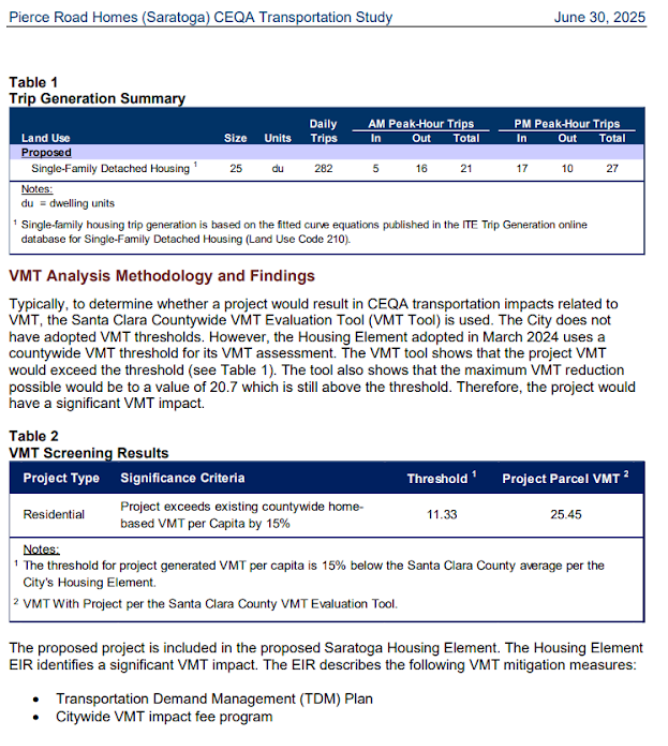
While many project types are shielded from VMT scrutiny, others encounter steep and sometimes prohibitive regulatory hurdles. For example, as shown in Figure 3, a 25 unit market-rate residential project in the City of Saratoga. The project’s traffic study said these 25 new units would generate 282 daily trips (Saratoga, 2025a). This relatively small residential project was found by the City to have significant unavoidable VMT impacts requiring mitigation despite it being expected to generate only 282 trips per day once built.
Another example of market-rate housing taking a beating from the new VMT system in California is the Neves Residential Project in the City of Hanford. This project that proposes 615 new single-family residential units was found by the City to have a significant and unavoidable impact related to VMT (Hanford 2025a). Despite this project proposing to provide 615 new residential units during a prolonged housing crisis in California, market-rate housing has been classified as “bad” by the SB 743 implementing policies, so these projects become more expensive and time consuming to build – delaying the construction of much-needed housing.
LOSER: Road and highway widening projects
An example of capacity increasing projects on roads becoming much more expensive due to VMT is the I-5 Managed Lanes Project (Red Hill Ave. to the OC/LA County Line). This project’s Toll Lane Alternative (Alternative 4) would add a new tolled express lane and would convert the existing HOV lanes to tolled express lanes with a cost of $340 million. The project’s Toll Lane Alternative was found by Caltrans to result in significant VMT increases due to widening and tolling, which their studies say will increase vehicular throughput. To mitigate these VMT impacts, Caltrans would be required to pay for over $450 million in VMT mitigation, primarily for new transit service and affordable housing (Caltrans 2023a). The idea is that by funding new transit services and affordable housing, the average VMT per capita for residents in the region would go down. This would more than double the project cost for this project from $340 million to $790 million, while only mitigating for approximately 26.1% of the project-generated VMT. This project shows how road and highway widening projects have not been completely stopped by the new VMT rules – instead, they have just been slowed down and made more expensive.
LOSER: Medium and larger-sized commercial and industrial projects
There are many projects across California that propose to provide new jobs, which are being made more expensive and more difficult to deliver due to the VMT rules. One example is the Lake Creek Logistics Center Project in the Town of Apple Valley. This project proposes construction and operation of three industrial buildings totaling approximately 3.48 million square feet on approximately 227 acres. The Project’s Draft EIR stated that the project would result in approximately 2,913 new employees, which is a substantial number of jobs for the Town of Apple Valley and for the surrounding region (Town of Apple Valley 2024a). The Town’s EIR’s determined that this project would result in a significant unavoidable impact related to VMT even though the applicant agreed to implement most of the applicable VMT mitigation measures that are available at this time. There simply are not enough feasible mitigation measures to reduce this project’s VMT. As a result, this Project was stuck preparing an EIR instead of potentially being able to proceed with a lower level environmental document, such as an Initial Study.
LOSER: Renters and Future Homeowners
The new VMT requirements are unfair to people who do not currently own a home. For example, in their Q&A style video on their VMT Program, Western Riverside Council of Government’s (WRCOG’s) video responded to the question of whether their VMT Program would make it more difficult for individuals to buy a home, WRCOG’s video stated that existing housing units would not be affected by the VMT Program – just new housing units would be affected.
You can watch the video here.
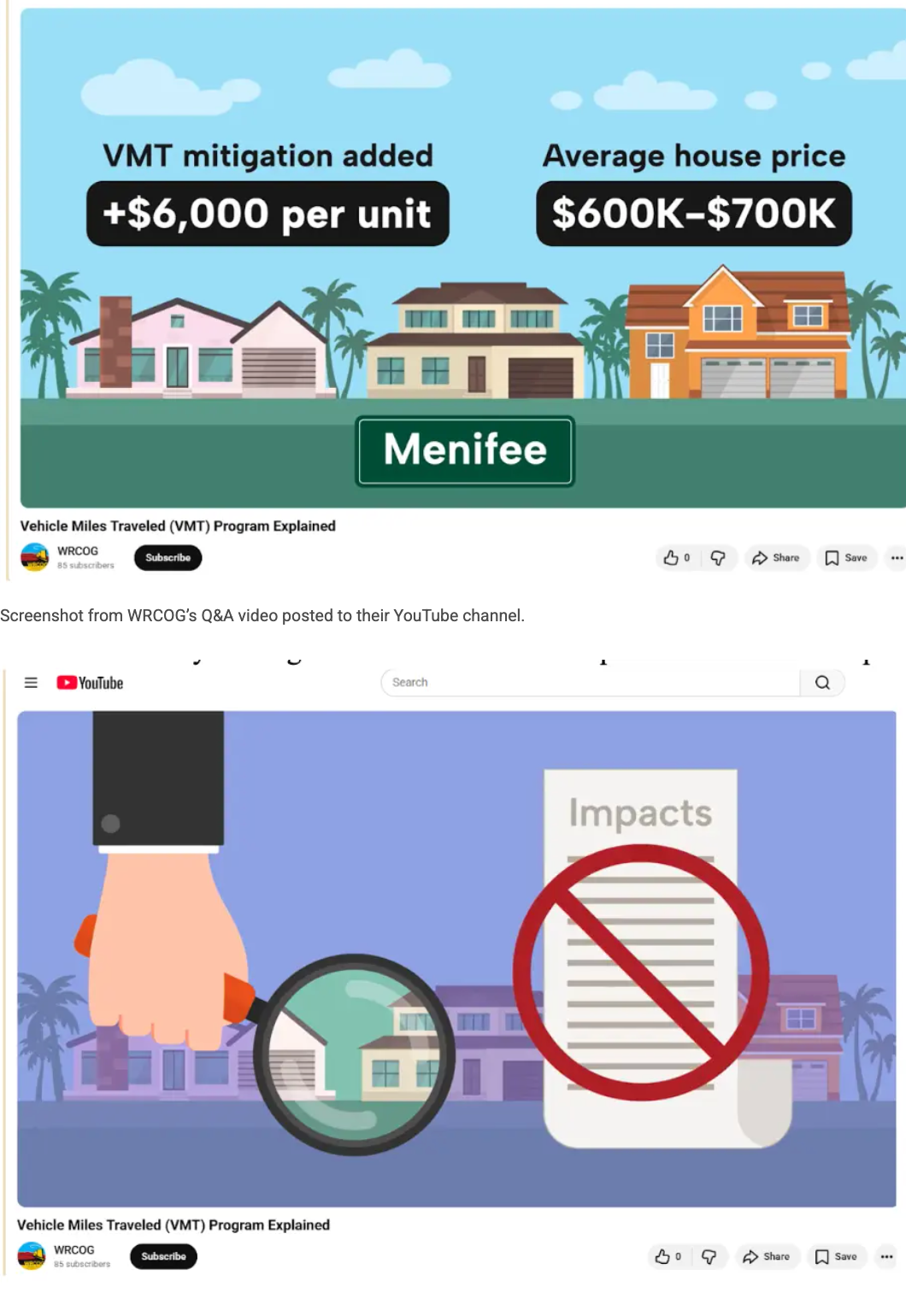
The WRCOG video stated that “WRCOG analyzed an example project in the City of Menifee, where mitigating the VMT impacts of the residential project added $6,000 per unit.” In the video, WRCOG goes on to downplay the $6,000 cost increase per unit by immediately comparing the $6,000 per unit to the average sales prices of a home in Menifee of $600,000 to $700,000 per unit (WRCOG 2025a). Lastly, they make the categorical and unsupported claim in the video that, “WRCOG has studied housing production and has found that residential development is not impacted by fees or other costs imposed by public agencies” (WRCOG 2025a). That’s a pretty bold claim to make! Don’t worry y’all, it’s just one percent more added on top of an already exorbitantly high purchase price for a home in Menifee. Case closed. Nothing to see here. Screenshots from the WRCOG video are provided below as Figures 4 and 5.
Conclusion:
While SB 743 was adopted with clear and important goals – to reduce greenhouse gas emissions, support infill development, and decrease dependence on private vehicles – the examples in this article illustrate that our current implementation of VMT analysis under CEQA is falling short of those goals. The system has created uneven outcomes: many project types that unquestionably increase VMT are exempt from analysis, while others, often those explicitly targeted by SB 743, face stricter evaluation, more burdensome mitigation requirements, and the litigation risk that comes with CEQA. In this article, I have pointed out specific project types that would provide housing and employment in areas where these resources are most needed, yet they are penalized by the new VMT regime. These inconsistencies not only undermine the fairness of the CEQA process, but they also prevent SB 743 from fully achieving its intended environmental and land-use objectives. For California to actually achieve the transformative goals of SB 743, we must refine the VMT evaluation framework so that it is applied equitably and aligns with the goals of more sustainable and climate-friendly development.
References
Apple Valley, Town of. 2025a. Lake Creek Logistics Center – Draft EIR and Transportation Study.
Accessible at: https://ceqanet.lci.ca.gov/2024020235
Caltrans. 2025a. I-5 Managed Lanes Project (Red Hill Avenue to Orange County/Los Angeles County
Line). Draft EIR/EA and VMT Study (Appendix J). Santa Ana, CA: Caltrans. Accessible at: https://ceqanet.lci.ca.gov/2022050172/2.
Corona, City of. 2025a. Northgate Gonzalez Market – Draft EIR and Transportation Study. Corona, CA:
Corona. Accessible at: https://ceqanet.lci.ca.gov/2025110646
Governor’s Office on Land Use and Climate Innovation. 2018a. Technical Advisory on Evaluating
Transportation Impacts in CEQA. Sacramento, CA. Accessible: https://lci.ca.gov/docs/20190122-743_Technical_Advisory.pdf
Hanford, City of. 2025a. Neves Residential Project – Draft EIR and Transportation Study. Hanford, CA:
Hanford. Accessible at: https://ceqanet.lci.ca.gov/2024120645
Miller Starr Regalia. 2025a. Fourth District Invalidates San Diego County’s “Infill” and “Small Project”
VMT Screening Thresholds as Lacking Substantial Evidence Support. Accessible: https://www.ceqadevelopments.com/2025/04/02/fourth-district-invalidates-san-diego-countys-infill-and-small-project-vmt-screening-thresholds-as-lacking-substantial-evidence-support/
Saratoga, City of. 2025a. Masson Estates – Draft EIR and Transportation Study. Saratoga, CA: Saratoga.
Accessible at: https://ceqanet.lci.ca.gov/2024050461/2
Walnut Creek, City of. 2025a. Mitchell Townhomes Project – Draft EIR and Transportation Study.
Walnut Creek, CA: Walnut Creek. Accessible at: https://ceqanet.lci.ca.gov/2024110923
Western Riverside Council of Governments. 2025a. Vehicle Miles Traveled (VMT) Program Explained
(You Tube video). Riverside, CA: WRCOG. Accessible at: https://youtu.be/cvY-nCGhPFc?si=TQ9y6AQzz-vbiwbL
