
At next Tuesday’s City Council meeting, the council will consider a deal to sell seven city-owned parcels near the Expo station to a developer proposing 301 affordable apartments, along with a large self-storage facility (Agenda, Item 4J.) The item is currently on the consent calendar, meaning staff expects it to be uncontroversial and pass unanimously.
A staff report recommends that the City Council authorize an Exclusive Negotiating Agreement (ENA) with Cypress Equity Investments (CEI). The company’s proposal calls for 301 affordable homes without a direct city subsidy, approximately 96,000 square feet of self-storage space, and a base purchase price of $30.25 million. That price could rise to $35 million if specified development conditions are met.
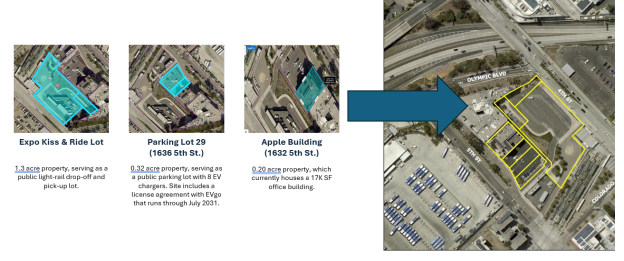
The properties cover approximately 1.85 acres along Fifth Street between Colorado Avenue and Olympic Boulevard. They include parcels at 1636-1640 Fifth Street and the Expo station Kiss & Ride lot, which was temporarily used by Palisades Charter High School following the January 2025 Palisades Fire.
The recommendation follows a previous, unsuccessful effort to develop the same land. In September 2023, the city entered exclusive negotiations with AMCAL Multi-Housing and Gen-Land, working with Lincoln Property Company, for a mixed-use project with approximately 570 residential units. The city ended those negotiations in July 2024 after determining the proposal was financially infeasible.
The city subsequently sought new proposals through a Request for Letters of Interest issued in May 2025. Six developers responded, offering purchase prices ranging from $7.3 million to $38 million.
Staff identified CEI, AMCAL and Lincoln Property Company as the three strongest proposals, evaluating them based on affordable housing production, purchase price, financial feasibility, developer experience and the likelihood of completing a transaction.
Although AMCAL offered a higher purchase price, staff raised concerns about the limited financing information it provided. Lincoln proposed fewer affordable homes and a lower purchase price, along with conditions that would require city policy commitments. Staff ultimately recommended CEI, citing its proposed affordable housing production, financial terms and development experience.
CEI says it has more than 1,000 residential units in its Santa Monica development pipeline, including 506 currently under construction. That experience helped support staff’s recommendation, although the city has not yet established that the proposed project is financially or technically feasible.
The developer anticipates needing 18 to 36 months to reach permit-ready status. It proposes closing on the property within 30 days after permits are ready for issuance, subject to approvals for the individual parcels. CEI expects to use the state’s 4% Low-Income Housing Tax Credit program to finance part of the affordable housing.
The proposed ENA would give the city and CEI six months to negotiate a potential Purchase and Sale Agreement, with one additional six-month extension possible by mutual agreement. During that time, CEI would conduct due diligence while city staff evaluate the company’s financing plan, anticipated tax credit awards, financial capacity, construction schedule and proposed closing conditions.
The negotiations will also need to account for changing market conditions. The staff report says the parties would revisit the purchase price, financing structure and development terms based on projected financing costs, tax credit availability and construction labor and materials costs. In other words, the $30.25 million base price and other terms in CEI’s 2025 proposal are starting points, not a final agreement.
CEI proposes a good-faith deposit of $907,500, equal to 3% of the base purchase price. The deposit would be refundable during an initial 90-day feasibility period and nonrefundable afterward, subject to terms and exceptions that have yet to be negotiated. The company would also provide a separate $50,000 deposit to cover eligible city costs associated with evaluating the project and negotiating the transaction.
The city must also confirm that the eventual sale complies with California’s Surplus Land Act. The seven parcels were declared surplus property through a series of City Council actions between 2021 and 2024. The state Department of Housing and Community Development confirmed the city’s compliance with applicable requirements in November 2024. Before a final disposition agreement, staff will need to verify that the project meets the law’s requirements, including a minimum of 15% lower-income housing and the associated affordability restrictions.
Other issues still to be resolved include the configuration of the parcels, the existing EVgo license, community engagement, development milestones and how costs and responsibilities would be divided between the city and developer.
The proposed agreement does not authorize construction or commit the city to sell the properties. If negotiations are successful, staff would return to the City Council with a proposed Purchase and Sale Agreement and any other necessary approvals. The project would also undergo separate environmental review before development could proceed.
For now, the council is being asked to give CEI an opportunity to work out a deal. Whether the proposal can deliver 301 affordable homes on the site, and on what financial terms, remains to be determined.
