
Santa Monica has spent years presenting itself as a city where walking, biking and transit are part of everyday life. The local school district has embraced that ethos too, at least informally, with route maps, weekly Car-Free Fridays, and a decade of walking and biking programs. Now local safe-streets advocates are asking a more specific question: Why hasn’t the Santa Monica-Malibu Unified School District ever put any of that into a formal, binding policy?
Santa Monica Families for Safe Streets and Streets For All are pushing the Santa Monica-Malibu Unified School District Board to adopt a formal Safe Routes to School policy and administrative regulation. You can sign their petition and e-mail the school board here.
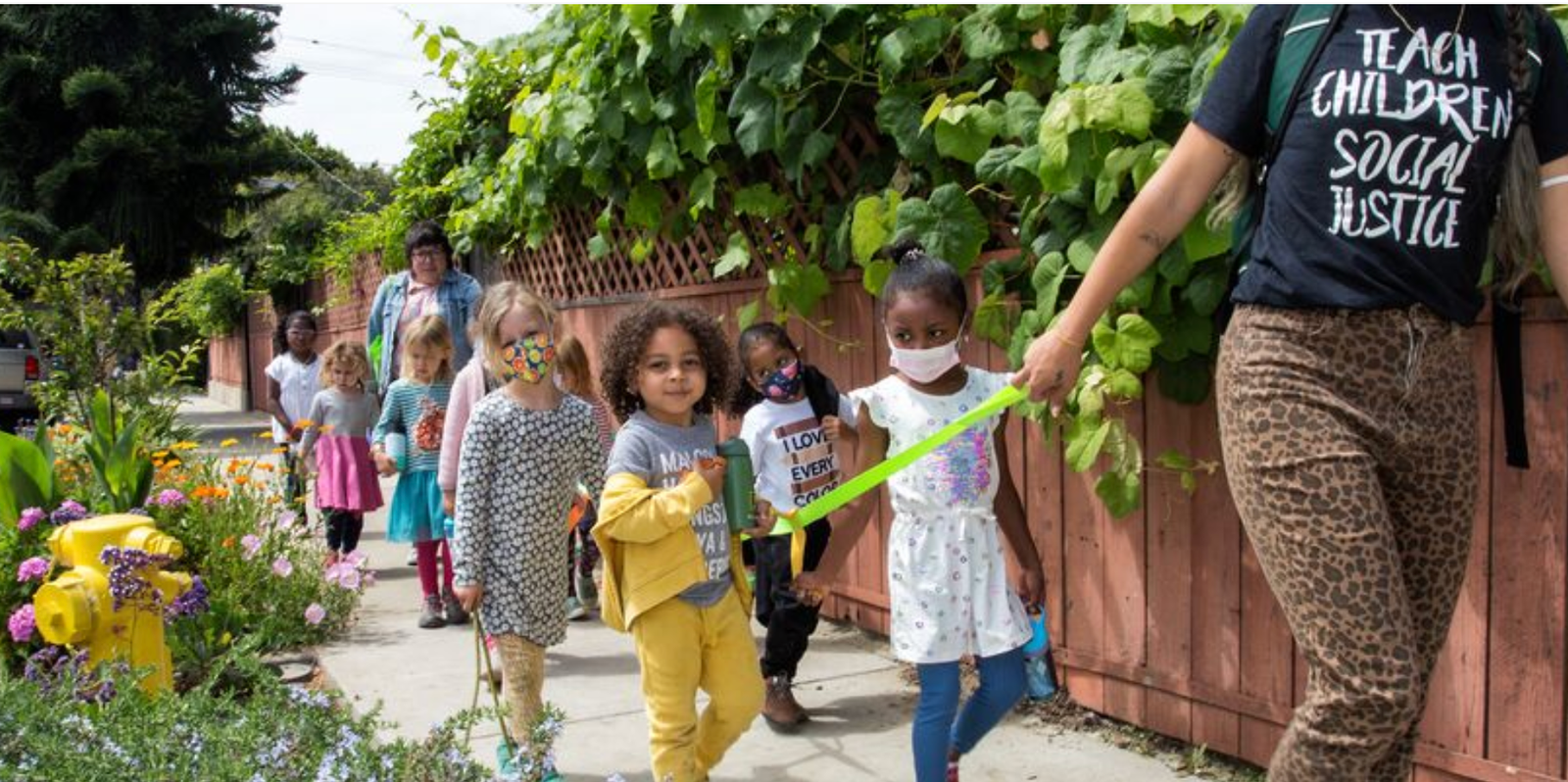
A Safe Routes to School policy formally commits a school district to making it safer and easier for students to walk, bike, roll, or take transit to school. It typically establishes responsibilities for things like traffic safety, school-site planning, education, encouragement, infrastructure coordination, and working with cities and transportation agencies.
The push was announced by SMMUSD parent, and Next contributor, Juan Matute at a recent Santa Monica-Malibu Unified School District meeting.
“Motor vehicle crashes are the number one cause of accidental deaths among children and teens in Los Angeles County,” explained Matute. “Our district is the only one in the Bay League that does not have a (Safe Routes to School) policy and I’m asking you to correct this in the near future.” You can listen to Matute’s full comments here.
Safe Routes History and Controversy
The absence of a formal policy does not mean SMMUSD has ignored how students get to school.
The district promotes Safe Routes to School on its website, including route maps for Santa Monica schools, and holds weekly Car-Free Fridays encouraging students and families to walk, bike or take the bus.
SMMUSD’s sustainability plan also describes Safe Routes to School as an existing district initiative. The program began in 2012 with grants supporting walking and biking curriculum, bike safety training, outreach and events at four schools, and expanded to all Santa Monica schools in 2015.
But in recent months, the district’s commitment has been called into question.
At a recent meeting, the City Council approved a new Vision Zero strategy and a contract for installation of new bike lanes. At the 11th hour, a letter signed by SMMUSD Superintendent Dr. Antonio Shelton called for school-specific safety criteria, formal district notification and input, continued public review of changes near campuses, and direct SMMUSD involvement in designing the 14th Street protected bikeway near Lincoln Middle School and Will Rogers Learning Community. While the letter repeatedly stated that it was supportive of Vision Zero and the bike lanes, the timing and concerns raised caused safe streets advocates to wonder about SMMSUD’s commitment.
What advocates are seeking is a formal policy that makes those efforts part of the district’s ongoing responsibilities rather than a collection of individual programs and partnerships.
“By adopting a dedicated Safe Routes to School Policy, the Santa Monica-Malibu Unified School District can work more effectively with cities to prioritize traffic safety, enhance school site safety plans, and ensure every student has a safe, accessible journey to school,” Santa Monica Families for Safe Streets says.
The City Has Been Doing This for Years
The disconnect is particularly striking because Santa Monica’s city government has been working on Safe Routes to School for more than a decade.
The city’s 2016 Pedestrian Action Plan identified Safe Routes to School as an immediate-action program and called for coordination between the city, SMMUSD and parent-teacher associations, along with systematic evaluation of streets around schools.
Santa Monica has also used Safe Routes funding for infrastructure. Improvements around Santa Monica High School included changes to Michigan Avenue and 7th Street, a new traffic signal at Pico Boulevard and 7th, and new bike lanes. The project was completed in 2016.
What’s Next
In his testimony, Matute warned that the district’s recent actions at Council and the perception that the district is slowing the city’s efforts to create safer streets is hurting the district’s public support.
“I am involved with one of the political groups in town that has endorsed Measure ES, and we plan to walk in support of ES,” he continued. “We have had some difficulty convincing our volunteer canvassers to support ES. First it was because of turf, now it’s the district’s opposition to safe streets.”
Following Matute’s testimony, School Board Member Laurie Lieberman commented that the board heard Matute’s comments. But while the campaign for a Safe Routes to School’s policy is just getting going, the ball is in the district’s court on when, and how, to respond.
