

Update, July 31 – SMMUSD responded to this story with a letter, reprinted here, that takes issue with several pieces of this story. We have reached out to the Coastal Commission for comment.
In January, the Santa Monica-Malibu Unified School District re-turfed the fields at the Ocean Park School House (known by many names locally, but most famously as the Santa Monica Alternative School House or SMASH) as part of its plan to repair and modernize the campus. The use of artificial turf instead of natural grass has been a hot topic in the school district, as parents and environmental activists have charged that it is bad for students and the environment. The District disagrees citing, amongst other things, the amount of water needed to maintain grass fields.
At the July meeting of the South Coast District for the California Coastal Commission (begin at 35:03), Dianne Woelke of the non-profit Safe Public Playing Fields charged that the re-turfing of the field at SMASH and another at a school in Malibu were illegal as the schools are within the zone where the Coastal Commission has permitting authority and there are no permits for the re-turfing on record. A few minutes later, responding to a question from Commission Vice Chair Caryl Hart, staff unequivocally called the SMMUSD projects “unpermitted,” said they were speaking with SMMUSD staff about next steps and that they could require the district to un-turf the areas.
You can watch the meeting here, the presentation on turfing at Santa Monica Schools by Wilke begins at the 29:00 mark. The staff response can be found below.
Responding to a question from Santa Monica Next, SMMUSD Chief Operations Officer Carey Upton explained that in the District’s view, a permit isn’t needed as the school has an exemption for projects at the school that was applied for and received as part of the permitting for the larger campus plan.
“To be precise about the legal mechanism: the District did not seek coastal development permits for the two Ocean Park School House projects (the former John Muir Elementary School and the Santa Monica Alternative School House),” Upton wrote. “Instead, it requested and received exemptions under the Coastal Act.”
However, the Coastal Commission is still demanding the district apply for a permit, even though the installation has been completed, and has been for over half of a year.
“Yes, this installation of artificial turf requires a coastal development permit,” writes Joshua Smith, a public information officer with the commission. “Staff is encouraging the school district to apply for a permit so that the project can be evaluated for consistency with the Coastal Act. Following a formal review process, it’s possible the commission could direct the school district to remove the turf.”
Turf War
For years, a group of concerned parents has been pushing the school district to end its use of artificial turf fields instead of natural grass. The District has been bullish that the turf fields are a better option citing the cost to maintain and the amount of water needed to keep grass fields usable during California’s seemingly never-ending droughts. Upton has even been a featured speaker at conferences extolling the virtue of turf fields.
However, there are certainly environmental concerns with using turf, especially in the amounts used by SMMUSD. Turf fields produce microplastic pollution, cause chemical contamination, and the urban heat island effect. They also require significant fossil fuels for production and generally end up in landfills after their 8-to-10-year lifespan.
Earlier this year, the Santa-Monica Malibu Parent Teacher Association (PTA) released a report recommending the district reconsider installing turf fields. The PTA Council eventually passed a version with softer recommendations than the initial report to the frustration of anti-turf advocates, including some members of the report’s study team. However, what was not changed was the language about the Coastal Commission and the Ocean Park Schoolhouse which was the same in the initial draft and final report:
“The Coastal Commission’s position on artificial turf may also make it very challenging for the District to get turf installations approved in the coastal zone (e.g., at Ocean Park Schoolhouse and any Malibu schools). For example, the Coastal Commission in 2023 voted 10-0 to deny 12 USCB’s application to install an artificial turf field in the coastal zone due to concerns regarding “plastic degradation, microplastic migration, chemical leaching, water quality impacts, and project-related water demand and sustainability aspects, amongst others.”
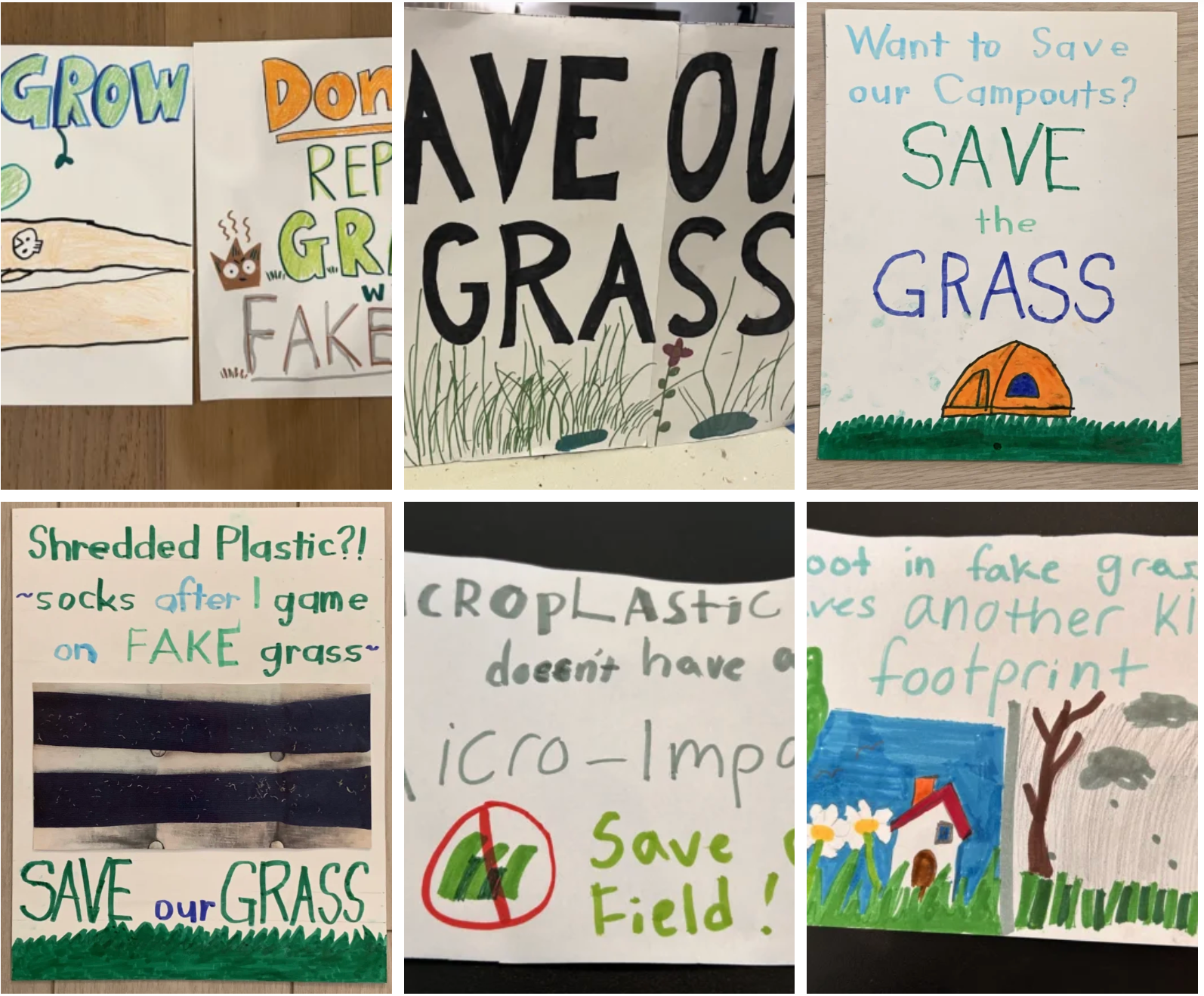
It’s not just parents pushing back against turf fields. All eight of the city’s neighborhood groups wrote a letter opposing turf fields earlier this year. The Santa Monica Democratic Club has passed a resolution against turf fields. Even the Santa Monica City Council has voted on a ban on turf at city-owned properties (which does NOT include SMMUSD properties.) Heck, even a group of second graders had an organized protest against turf.
Last year, as the debate grew, the SMMUSD Board of Education directed staff to commission an independent third-party study which analyzed the tradeoffs between grass and turf. In short the analyzed the tradeoff as:
Natural grass has lower surface temperatures, avoids microplastics and PFAS concerns, and generally has a lower environmental impact, but requires much more water, labor, fertilizer, herbicides, and downtime for recovery.
Artificial turf provides far greater playing capacity, requires much less maintenance and irrigation, and allows year-round use, but raises concerns about heat, PFAS, microplastics, and disposal at the end of its life.
Following the report’s release, the school district decided to go back to grass fields, at least for now, and authorized a one-year pilot program for a grass field at Franklin Elementary.
Under the pilot program, the district will evaluate whether modern, drought-tolerant natural grass can withstand the heavy use of school and community sports while remaining cost-effective. Existing synthetic turf fields will remain in place as the district gathers data on maintenance, water use, durability, and playability before making long-term decisions about future field conversions.
And while advocates were happy with the announcement of the grass field at Franklin, concerns remain about planned campus renovations at McKinley and Roosevelt elementaries in the coming years.
Temperatures at Existing Fields?
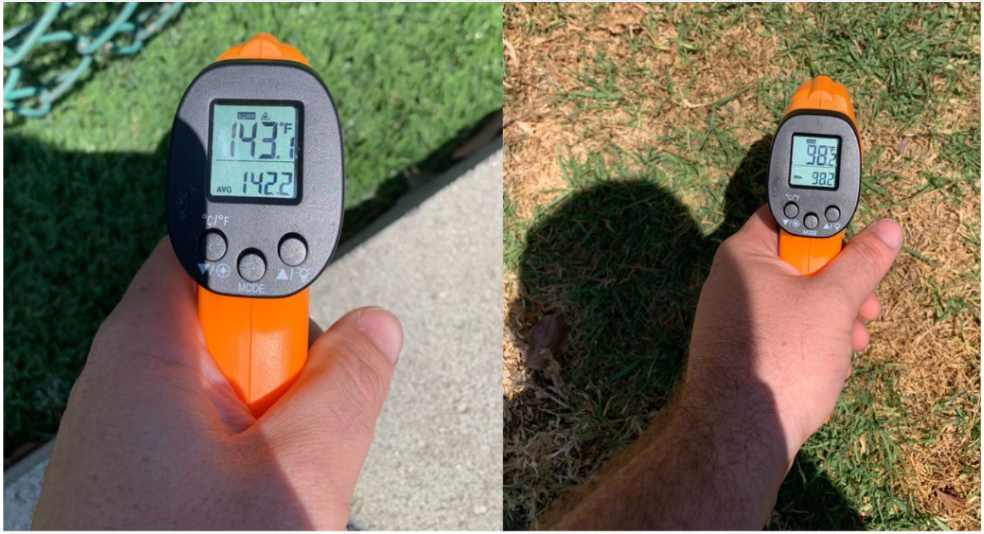
But the changes for Franklin don’t mark the end of the campaign against turf. Last week, an SMMUSD parent went to the campus with a thermal thermometer to take heat readings from the field. Temperatures at field level ranged from 138-143 degrees. Wandering over to a nearby grass patch, the temperature fell to 98 degrees.
The international standard for the heat at which surfaces should be avoided is 122 degrees fahrenheit (if you want more details on the science, click here) although most governing bodies recommend aiming for temperatures in the double digits, closer to the 98 degrees caught on the grass surfaces.
Responding to questions about the temperatures, Upton responded that the district hasn’t done temperature readings itself at the fields, but, “Surface temperature on any material, including turf, grass, concrete, or asphalt, varies substantially with sun exposure, time of day, and exactly where and how a reading is taken, so a single reading is difficult to interpret on its own.”
At its June meeting, the Board of Education directed staff to “study elementary grass and synthetic turf across multiple factors, including heat. The study runs through the 2026–27 school year and will give the Board local data to guide its decisions.”
