

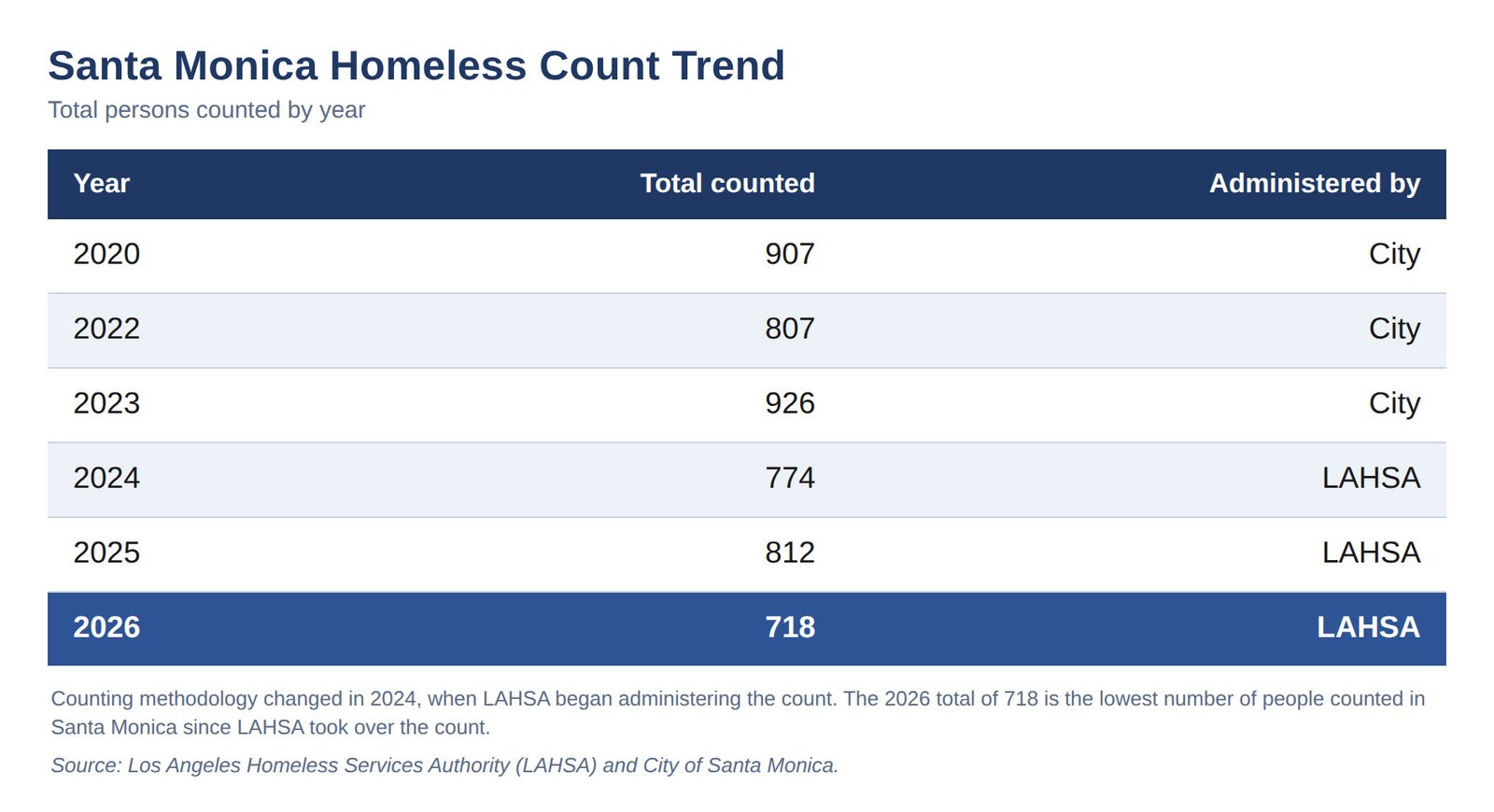
The number of people experiencing homelessness in Santa Monica fell by nearly 12 percent over the past year, according to the 2026 Point-in-Time Count released by the Los Angeles Homeless Services Authority (LAHSA) on Friday. The local numbers bucked the regional trend as homelessness rose slightly in the City of Los Angeles City (3.4%) and Los Angeles County (1.2%) compared to the 2025 counts.
The annual census counted 718 people experiencing homelessness in Santa Monica, down from 812 in 2025, an 11.6 percent decline. The number of people living unsheltered dropped even more sharply, falling 18.7 percent over the same period.
City officials hailed the results as evidence that investments in outreach, shelter, and homelessness prevention are beginning to pay off.
“Behind every one of these numbers is a person, and behind this progress is a community that refuses to treat homelessness as inevitable,” Mayor Caroline Torosis said in a statement. “This is what happens when a city stays committed to keeping people housed. We’re proud of this milestone, and we are not slowing down.”
The count found 389 people living outdoors, including on city beaches, down from 475 last year. The number of people staying in shelters increased from 202 to 222, suggesting more people moved indoors during the year.
The city also saw a significant decline in vehicle homelessness. Occupied vehicles dropped from 84 to 59, with the steepest decrease occurring among people living in vans, which fell from 52 to 34. Vehicle homelessness had been the primary driver of Santa Monica’s increase in the 2025 count.
While the overall trend was positive, not every measure improved. Recreational vehicles counted as improvised dwellings increased from nine to 11, while makeshift shelters rose from 31 to 34. City officials cautioned that the Point-in-Time Count captures conditions on a single night and can fluctuate from year to year, making it one indicator rather than a definitive measure of long-term trends.
Santa Monica Housing and Human Services Director Aileen Reynolds credited the city’s coordinated approach.
“This decline reflects what a dedicated system of care can achieve when we meet people where they are and connect them to services right away,” Reynolds said. “At the same time, we know our work is not done. We’ll keep following the data, strengthening our partnerships, and building upon the housing-focused infrastructure that brings lasting stability for our neighbors.”
City officials pointed to several initiatives launched over the past year, including implementation of the Homelessness Strategic Plan adopted in March 2025. The plan aligns city departments around four priorities: prevention, intervention, coordination, and communication, while tying homelessness response into the city’s broader Realignment Plan.
Officials also highlighted the first year of the city’s SaMo Bridge diversion program, a 24-hour respite center where Santa Monica police can take people accused of minor offenses instead of booking them into jail. Since opening in April 2025, the program has received 462 referrals, started 363 people on 90-day care coordination plans, and connected 233 participants to services. According to the city, 81 percent of those individuals were immediately placed into housing or treatment programs, and 54 participants completed the program and became eligible to have citations dismissed.
The city also cited expanded outreach by nonprofit partners, growth of the Police Department’s Homeless Liaison Program, continued funding for eviction defense through the Right to Counsel program, and Project Homecoming, which has reunited more than 3,200 people with family or support networks since 2006.
Recognizing the limitations of relying on a single annual count, Santa Monica plans to begin collecting homelessness data more frequently. Beginning later this summer, the RAND Corporation will conduct unsheltered counts six times a year between 10 p.m. and 1 a.m., replacing reliance on the annual Point-in-Time snapshot.
The bi-monthly counts will also include voluntary, anonymous surveys designed to gather information unavailable through the traditional count, including how long people have lived in Santa Monica, what services they are using, and what barriers they face in obtaining housing. RAND will publish quarterly reports and an annual summary without collecting names or other identifying information.
Because LAHSA changed its counting methodology in 2024, city officials note that the 2026 total represents the lowest homelessness count recorded during the LAHSA-administered era and should not be directly compared with earlier city-run counts.
