

“Well, the good news is, we’ll have plenty of chances to educate,” sighed one bicycle safety advocate to me after a series of well-intentioned but harmful e-bike legislation moved in the Assembly Transportation Committee last April. But while all sorts of e-bike related legislation was moving in April, only the legislation endorsed by safety groups throughout the state survived May.
The Good Legislation That Is Still Alive
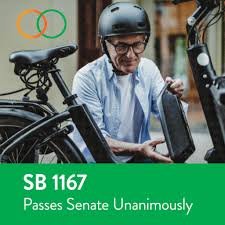
The most important of those is Senate Bill 1167, Vehicles: Electric Bicycles, seeks to define the differences between e-bikes and e-motos, authored by Catherine Blakespear (D-Encinitas).
Most of the e-bike legislation introduced this session was introduced because more and more people are involved in dangerous, or even deadly crashes, involving e-bikes or their evil, faster, cousins: e-motorcycles disguised as e-bikes.
Throughout the state, municipalities are struggling with how best to create a safe framework for younger and older e-bike riders while maintaining safe places for pedestrians and regular bike riders. This has created a mismatch of rules and regulations that change from municipality to municipality.
Electric bicycles are already well-defined under state and federal law. Yet increasingly, manufacturers and retailers are marketing high-powered electric motorcycles—often exceeding 750 watts and capable of motorcycle-like speeds—as “e-bikes,” particularly to young riders.
SB 1167 draws a clear distinction. The bill preserves the legal status of legitimate Class 1, 2, and 3 e-bikes while ensuring that higher-powered electric motorcycles and mopeds are accurately labeled, fully disclosed to consumers, and regulated as motor vehicles.
SB 1167 has passed the Senate completely, and is awaiting its first hearing in the Assembly.
Assembly Bill 1569, Pupil safety: electric bicycle: safety and training program, introduced by Laurie Davis (R-Oceanside) and Philip Chen (R-Brea) passed the Assembly and has been assigned to the Senate Transportation and Education Committees. The legislation requires K-12 students to complete a standardized e-bike safety and training program before they can park their electric bicycles on school campuses.
The following E-Bike/E-Moto Legislation Will Not Move Forward This Year
Assembly Bill 1557, Vehicles: Electric Bicycles, would limit the motor output of e-bikes sold in the state to a maximum of 750 watts, aligning with existing federal e-bike definitions. The legislation passed the Assembly Transportation Committee, but didn’t receive a vote in the Appropriations Committee before the deadline.
The California Bicycle Coalition, Streets for All, the East Bay Bicycle Coalition, and just about every bicycle rider advocacy group in the state opposed the legislation because it would have limited motor size and wattage beyond current definitions in ways that would have made it hard for bike shops to survive and for people to access e-bikes. While Assemblymember Diane Papan (D-San Mateo) seemed sincere in her efforts to reduce crashes, the effectiveness of the legislation was questioned at every turn.
Assembly Bill 1942, the E-Bike Accountability Act, would require owners of Class 2 and Class 3 electric bicycles to register those bikes with the California Department of Motor Vehicles and display a special license plate issued by the DMV. It passed the Transportation Committee but did not receive a vote in the Appropriations Committee and will not move this session.
Assembly Bill 2284, Electric bicycles: Attorney General list, would require CHP to publish a list of devices marketed as e-bikes that are not actually legal e-bikes. The legislation failed to pass the Transportation Committee and has been defeated for this session.
