
Donald Trump’s National Oceanic and Atmospheric Administration (NOAA) rolled into Santa Monica today to hold a hearing on the federal government’s plans to open up California’s coastal waters to oil and gas drilling, floating nuclear power plants (really!), rocket testing, and other questionable uses. Trump is using NOAA to challenge California’s – and only California’s – right to protect its coastlines.
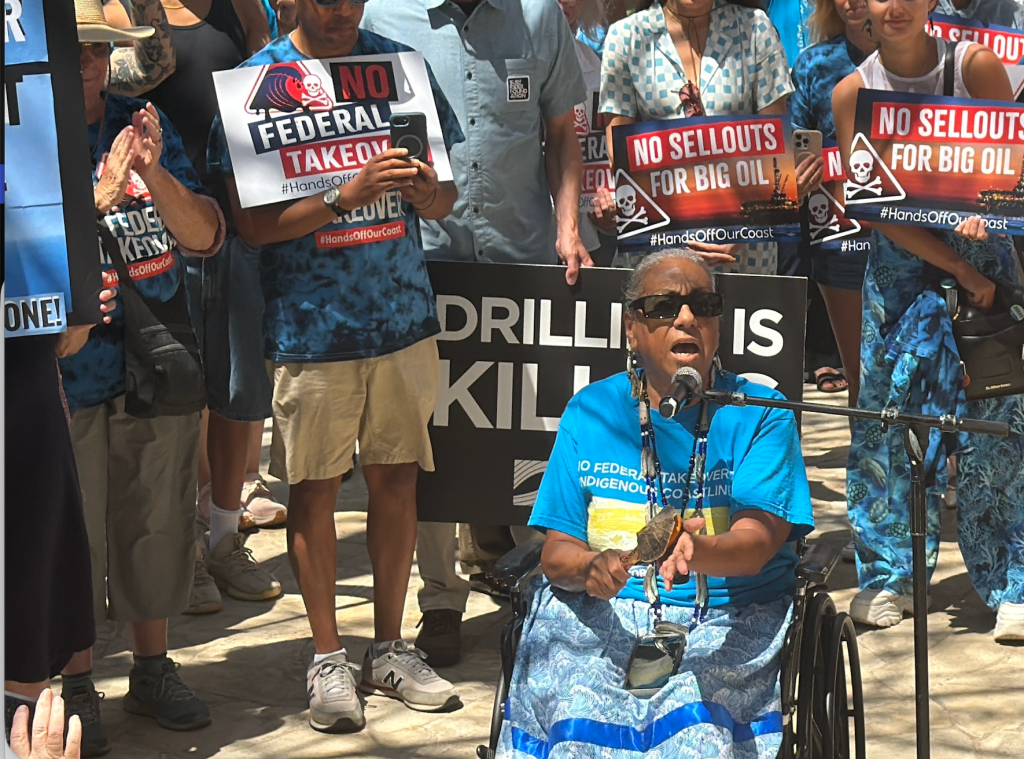
Needless to say, California is not taking this lying down. Tribal leaders, environmental groups, local political leaders (Councilmember Lana Negrete was among those waiving signs behind speakers, while former mayor Pam O’Connor sat in the audience), and others gathered in the courtyard for a noon rally before the 2 p.m. meeting to tell the Trump Administration that California’s coast is not for sale.
“We know what is best for Los Angeles County, for California, and for our nation,” argued Los Angeles County Supervisor Lindsey Horvath, after arguing that the Trump Administration is intentionally pushing policies that hurt Californians. “If they wanted to really help our communities, they would release billions of disaster aid to help our coastal communities desperate to rebuild their lives after the Palisades Fire.”
At the rally before the hearing, speaker after speaker took to the podium to denounce not just the idea that politics is clouding California’s environmental regulations, but just the opposite: that political concerns were pushing the administration’s attacks on California to the benefit of Trump’s political donors.
“We’ll keep fighting, but we know what’s going to happen today,” stated Congressman Dave Min (D-Irvine). “A bunch of you are going to go in and give your testimony, and this rigged review is going to come to the conclusion that has been preordained.”
Trump’s Plan
The Trump administration is reopening a federal review of California’s Coastal Management Program, raising the possibility that the state could lose some of its longstanding authority to protect its coastline should he succeed.
The program, which has been federally approved since 1978, operates under the federal Coastal Zone Management Act. It gives California a role in reviewing federally regulated projects that could affect the state’s coastal resources, including projects in federal waters. The California Coastal Commission, State Coastal Conservancy, and San Francisco Bay Conservation and Development Commission all play roles in implementing the program.
That authority has allowed California to challenge or modify projects ranging from offshore oil development to pipelines, desalination facilities and rocket launches. Despite Trump’s claim that the state should lose its rights because of “environmental extremism,” the Coastal Commission has reviewed thousands of federally regulated projects over the decades, but has opposed only a small percentage of them.
NOAA is conducting a new review of the state’s coastal program after Commerce Secretary Howard Lutnick accused California of using its coastal authority to obstruct projects favored by the administration for political reasons.
Among the examples cited by federal officials is California’s opposition to expanded SpaceX rocket launches from Vandenberg Space Force Base. SpaceX has been firing test rockets from the base for the last half dozen years. But, the state has asked for more oversight of all rocket launches marines from Vandenberg accidentally fired 155-millimeter artillery shells over a major freeway in Southern California.
State officials, however, argue that the review is part of a broader effort to remove obstacles to the Trump administration’s plans for the coast, particularly its push to expand offshore oil and gas drilling.
Speaking at today’s hearing, Wade Crowfoot, California Secretary for Natural Resources, noted that after states were given greater purview in enforcing environmental standards for projects nearly six decades ago, the states participating in the Coastal Zone Management Act have approved 95% of the federally requested projects. In that same time, California had approved 96% of the projects.
Crowfoot continued with the theme that the federal review is more about politics and Trump’s feelings towards California than about policy.
“Americans across the country share the concerns we do about the health and safety of our coasts. The Trump Administration proposed expanded offshore oil drilling in the states of Florida, North Carolina, South Carolina, and California. When leaders of three states expressed strong concerns on behalf of their constituents, the federal government backed off those proposals…Yet they continue to target California,” he testified. Florida, North Carolina, and South Carolina all voted for Trump in 2024.
The administration has proposed opening federal waters off California to new oil and gas leasing, something that has not happened in decades. It has also sought to restart the Sable pipeline, which has been shut down since the 2015 Refugio oil spill. Recently, the government spent billions of dollars to stop wind farms and other renewable energy projects from being built.
California’s coastal program was already reviewed under the previous administration. NOAA’s 2024 review included public meetings and stakeholder input, and a draft report completed in 2025 found that California had successfully implemented and enforced its federally approved program. The Trump administration nevertheless ordered another review.
If the federal government ultimately determines that California’s program does not comply with federal requirements, it could seek changes to the program or move toward decertification. That could weaken the state’s ability to challenge federal projects and put federal funding connected to the program at risk.
The confrontation is unusual enough that legal experts told the Los Angeles Times they were unaware of another instance in which the federal government had stripped a coastal state of its rights under the Coastal Zone Management Act. What happens in California could therefore establish a precedent for the relationship between the federal government and coastal states elsewhere.
You Can Still Submit Comment
Californians who want to push back against the Trump administration’s effort to weaken the state’s coastal protections have a relatively simple place to start: tell the federal government what you think. You can submit your own comment electronically, here.
While the only in-person meeting was held (or is being held depending when you’re reading this) today, there are virtual meetings tomorrow and Wednesday, August 11 and 12. For more details on those meetings, click here.
“Trump is threatening California’s coast in pursuit of reckless offshore oil and gas extraction to pad the wallets of his corrupt oil cronies,” Newsom said in a statement. “We won’t stand by while Trump sidelines the people who rely on and care for California’s coast. Now is the time to make our voices heard. Give the Trump administration an earful.”
You can read the state’s official comments, here.
