
The crossing guard at Chelsea Avenue and Santa Monica Boulevard has been waving McKinley kids across the street for almost twenty years, and for much of that time she’s had to watch out for left-turning drivers who didn’t see her or stop in time. I know this as a McKinley parent, a member of the school’s PTA Traffic Safety Committee who pushed for this redesign, and someone who studies transportation for a living. The city redesigned that left turn earlier this year. Conflicts dropped, drivers made better choices at the intersection, and the crossing guard is happy. So am I.
That intersection is item one on a list of nine near-term projects in a staff report that Council will take up on September 8, and it’s a big part of why I’m optimistic about the rest of the report. It’s honest about why Santa Monica didn’t hit the zero-fatality goal it set a decade ago, and it lays out a real plan for what comes next. I’ve written before about pieces of this story: declining traffic enforcement staffing after the Wilshire and Chelsea fatality, and new automated-enforcement authority last winter. September 8 brings a lot of that together, and I support it.
The City missed its Vision Zero goal, but found a better framework
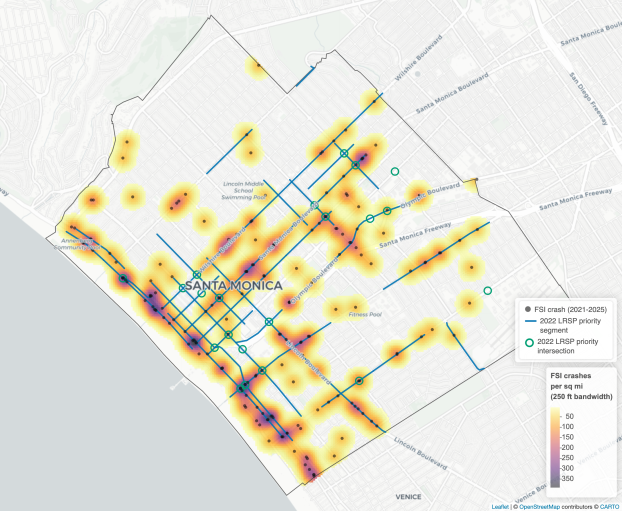
In February 2016, the city committed to eliminating fatal and severe-injury crashes by 2026. That year is here, and the results are mixed. Total fatal and severe-injury crashes fell from 62 in 2024 to 52 in 2025. But pedestrian-involved crashes went up every year from 2021 to 2025, and pedestrians and cyclists made up 20 of the city’s 21 traffic deaths over that period. No single intersection had more than three of these crashes over five years, though Ocean Avenue and Santa Monica Boulevard each had 26. The problem is spread across the city, not concentrated at a couple of bad corners.
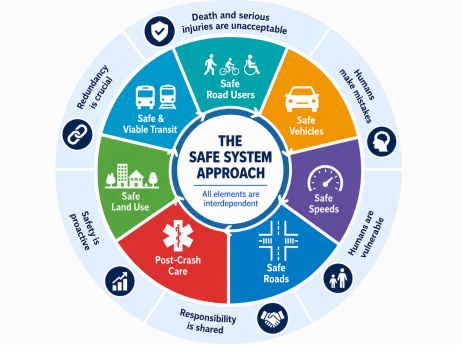
Staff wants to replace the old five-E model (engineering, education, encouragement, enforcement, evaluation) with a modified Safe System approach built around seven elements: Safe Speeds, Safe Roads, Safe Road Users, Safe Vehicles, Post-Crash Care and Learning, Safe Land Use, and Safe and Viable Transit. I like this framework, especially the last two additions. Safe Land Use and Safe and Viable Transit fit Santa Monica well because much of the danger on our streets comes down to how far people have to drive for everyday things, and how good the transit option is when they’d rather not drive.
A toolkit for empowering neighborhoods
The most concrete piece of the report is a Neighborhood Traffic Calming Toolkit paired with a new diverter pilot program. It gives residents a structured way to flag a safety problem on their street (e.g., daylighting, curb extensions, speed humps, diverters) and get it addressed on a predictable timeline instead of waiting years for a capital project to work its way through the budget.
The toolkit sets a reasonable line between two paths. Diverters that fit an already approved program go through administrative review: engineering analysis, interdepartmental review, public notice, and monitoring. New or nonstandard proposals need documented neighborhood support first: 51 percent of residents and businesses in areas zoned mostly R-1, 25 percent in more mixed zoning, the same threshold the city already uses for Block Party street closures. That keeps circulation changes accountable to the people who actually live with them, since a diverter redirects cut-through traffic rather than eliminating it.
This is also where the city’s grid matters. Santa Monica has real route redundancy because our streets are connected, but that only helps if diverters are evaluated at the network level, so a fix on one street doesn’t just push the same traffic onto the next one, and emergency responders keep the routes they need. The Michigan Avenue greenway shows this working as intended: the city set a target back in 2014 of 1,500 or fewer daily car trips on that street, but any actual diverter still needs Council approval, since Michigan absorbs cut-through traffic that Olympic, as the regional road, is supposed to handle instead. Washington Avenue is in earlier stages, with a quick-build greenway now funded.
Red light cameras, and why the fine amount doesn’t tell the whole story
Running a red light and driving at unsafe speed are two of the most dangerous things a driver can do, and state law treats them separately. AB 645 allows automated speed cameras, but only in a handful of pilot cities, including Los Angeles and Malibu. Santa Monica isn’t one of them. SB 720 provides the broader authority for red-light and stop-sign cameras, and the ordinance coming to Council for a first reading relies on it: cameras at two signalized intersections. I wish it were more, but two is a start.
Without state authorization for automated speed enforcement, Santa Monica is handling the speed side manually. SMPD expanded traffic enforcement staffing this year and has been putting officers at school sites in the morning, which I think has been good for children’s safety. For signals and stop signs, though, cameras are the tool state law actually gives us right now.
The fine schedule is $100 for a first violation, rising to $500 by a fourth, plus a $50 late fee. It’s civil rather than criminal, attached to the registered owner of the vehicle. Some people will look at that and assume it’s too small to matter. I don’t think that’s right. A fine only deters if people expect to get caught, and an officer working an intersection manually might cite fewer than two speeding drivers an hour. A camera catches almost everyone who runs the light. When the odds of getting caught go up that much, the fine doesn’t need to be as high to have the same effect.
Curb space is a safety issue too
I’m glad to see smart curb management included here, with a pilot planned for 2nd and 4th Streets. This is something I’ve researched in the past: competition for curb space in our business districts pushes a lot of delivery and rideshare vehicles into double-parking, and a lot of that double-parking happens in bike lanes, which is dangerous for cyclists and makes it harder to see pedestrians at intersections. A pilot that uses data and defined zones to allocate that space more predictably addresses a real problem.
What Council is actually deciding
There’s no immediate budget action tied to this study session. Council is being asked for direction, not money, and any ATES fine revenue is meant to stay limited, since the program’s point is near-certain enforcement and putting any surplus into local roadway safety improvements rather than raising general fund revenue. What Council decides on September 8 is whether to adopt the Safe System framework, move the traffic calming toolkit and diverter process forward, advance the curb and parking pilots, and introduce the ATES ordinance.
Author
About The Author