

Every week, Santa Monica Next republishes a story from City Manager Oliver Chi’s newsletter to staff.
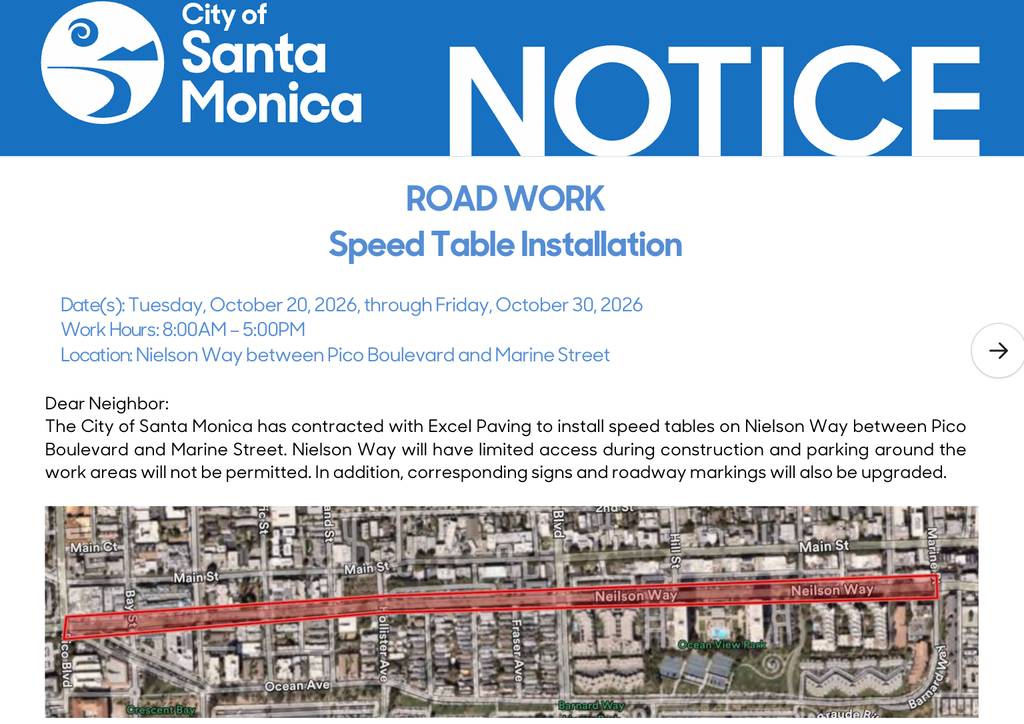
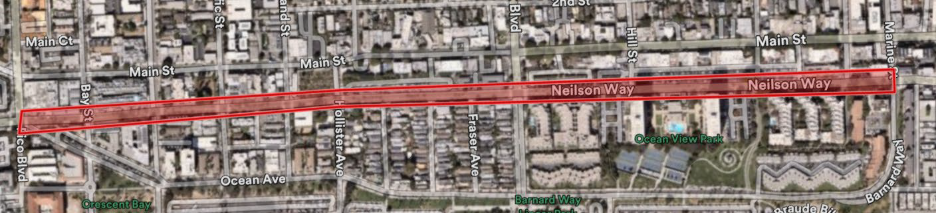
Work to install new speed tables on Neilson Way between Pico Boulevard and Marine Street begins Tuesday, October 20, and is expected to wrap by Friday, October 30, with crews working 8 a.m. to 5 p.m. during each day of construction.
The overall project includes the installation of new signs and roadway markings, along with the speed tables themselves. Of note, the speed tables function like elongated speed humps to bring vehicle speeds down on an important corridor which carries beachgoers, cyclists, and Ocean Park neighbors every day.
As we prepare to start this work, we wanted to let everyone know that message boards are already up; sections of Neilson will close intermittently with detours and traffic control staff in place; driveway access will be maintained; and we are asking drivers to use alternate routes where possible and watch for temporary no-parking signs. We do truly appreciate everyone’s patience while this work is underway!
This new enhancement builds on the speed limit reduction that was instituted in 2024 on this same stretch of road, reducing speed limits from 30 mph to 25 mph. Of note, the installation of these new speed tables on Neilson Way is part of the Neighborhood Traffic Calming Toolkit that staff presented at the September Safe System study session, which included a set of rapid, quick-build measures (including speed humps, speed tables, feedback signs, and all-way stops) which are designed to be installed over the course of weeks rather than years.
Earlier this year, as part of the Realignment Plan, we reorganized our mobility and transportation functions into Public Works so that planning, civil engineering, and capital delivery sit together on one team. The improvements we’re now making on Neilson Way serve as a demonstration of why that organizational adjustment was made. A safety improvement that would once have moved through multiple departments and would have required a multi-year capital cycle instead went from design to installation on a quick-build timeline, delivered by our own operation. Great work by our Public Works team, and we’re all looking forward to seeing more improvements like this as the toolkit rolls out to other neighborhoods!
