

Give them liberty … and give us death.
A forthcoming federal bill proposes to outlaw speed- and red-light cameras under the cover of legitimate, but unrelated, mass surveillance fears.
Flock Safety, which operates more than 120,000 surveillance cameras across the country, is under fire for a growing number of data breaches, stalking incidents, and wrongful arrests. Police have been caught 28 times abusing their system access to stalk romantic interests in the past several years, according to public interest law firm Institute for Justice. In one case this year, a Milwaukee police officer pleaded guilty to using the system to stalk an ex-partner 124 times.
Now, Republicans may be using Flock opposition – and confusion – to advance their war on safety. Rep. Thomas Massie (R-Ky.) announced earlier this week that he is introducing legislation to “withhold federal money from municipalities and police departments that deploy Flock (and other style) cameras to surveil law-abiding citizens.” (Emphasis added.)
Should that “other style” include speed- and red-light cameras, the bill would effectively ban traffic enforcement on local roads nationwide and lead to hundreds of fatalities. (But, then again, people caught on such cameras are not “law-abiding…”)
Speed- and red-light cameras prevent hundreds of road deaths every year, but they collect far less data, and under more-strict regulations, than Flock’s devices. For instance, traffic enforcement cameras do not collect data except when prompted to do so by an active violation. A transgressing driver sets off a trigger, either by running through a red light or traveling above the speed limit, which prompts the camera to take one to two photos.
Drivers who do not violate the law are not photographed by traffic enforcement cameras. But libertarians like Massie still object to speed cameras, which are derided as a “money grab.”
This form of automated enforcement technology was developed in the 1980s. In San Francisco, speeding dropped by 72 percent at key locations after cameras were installed last year. Boulder Springs, Colorado reduced red light-running violations by the same percentage in its first year of enforcement. In New York City, which has the largest automated camera system, collisions declined by 30 percent and injuries by 16 percent in the the seven months following the introduction of a camera, the local Department of Transportation reported.
Traffic enforcement cameras deter reckless driving by capturing specific illegal behaviors. Flock cameras watch everyone, everywhere, all of the time.
The company operates a national network of Automated License Plate Readers that scan for, and log, every plate that comes into view. Every vehicle in frame is sent to a broader database that anyone to whom Flock grants access can see.
Last year, the company introduced FreeForm, an AI search tool enabling its clients to parse data using plain language searches. A law enforcement officer could search “red SUV with dent on rear bumper” and find every image of a specific vehicle captured by Flock. Police could then compile that information into a detailed history of the vehicle occupants’ location.
“We’re making it easier than ever for investigators to track down vehicles of interest,” the company said in an announcement.
Automated traffic enforcement and plate reading systems differ enormously in the quantity of data they collect and what can be done with it. Few Americans can actually tell the difference – and many are taking their frustrations out on the wrong cameras.
One enraged X user tagged Fox News in a post: “I received a speeding ticket as a result of a flock camera! I was going ONE MILE over the speed limit. ONE!!!!!”
Under differing state laws, speed cameras don’t issue tickets until violators are driving many miles per hour — in New York City, it is 11 mph — above the limit. Even more puzzlingly, Flock does not issue speeding tickets.
The company itself has blurred the line between its plate readers and traditional speed enforcement. Its website used to claim that it does not “perform facial recognition, does not store biometrics, cannot be queried to find people, and is not used to enforce traffic violations.” Sometime after Dec. 2, 2025, it quietly removed that last commitment.
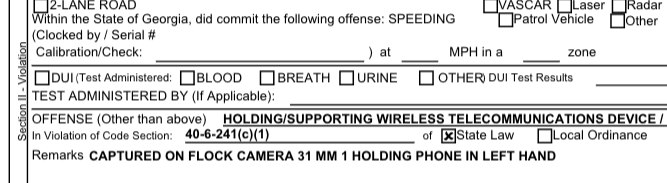
Just three weeks later, Flock had already gone back on its commitment. A Georgia State Patrol officer used a Flock license plate reader to ticket a motorcyclist for holding his phone, as first reported by 404 Media.
Massie’s legislation is not the Republicans’ first attempt this term at enacting The Purge on US roads. A bill by Rep. Pat Harrigan (R-N.C.) would ban speed cameras by withholding federal highway funds from states.
Increased conflation between privately operated license plate readers and standard traffic enforcement could increase public support for anti-speed enforcement bills – including the ones that won’t rein in Flock at all.
Whether by panicked confusion or targeted destruction, automated traffic enforcement is under attack. That attack won’t disarm mass surveillance, but it will cause thousands of Americans to die on the road.
